Kitchen Benchtop Resurfacing Cost in Sydney: When It Makes Sense and When Replacing Is Cheaper Long Term
People searching for benchtop resurfacing cost are usually trying to avoid the price of a new kitchen. Sometimes that is exactly right. Here is what resurfacing really involves, what replacement costs per metre, and the honest test for choosing between them.
TL;DR: Benchtop resurfacing means coating your existing top — usually a sprayed or trowelled finish over old laminate or stone — while replacing means a new benchtop cut to your cabinets. Resurfacing is cheaper up front and is a specialist coating trade, not joinery. Replacement runs roughly $80–$200 per linear metre installed for laminate and roughly $400–$900 for engineered stone or porcelain, and a new benchtop and splashback typically adds $3,000–$7,000 to a kitchen refinish. We replace benchtops rather than coat them, and this article explains when each option is the honest answer.
Resurfacing and Replacing Are Two Different Trades
I'm a licensed contractor based in Liverpool, and I should say up front what we do and do not do, because it shapes the advice. We build and install kitchens and joinery. When a benchtop is tired, we replace it — measure, template, cut a new top in laminate, engineered stone, porcelain or timber, and fit it to the existing or new cabinets. We do not spray-coat benchtops. That is a separate specialist trade, and it is worth understanding before you compare prices, because the two options are not the same product at different costs.
Benchtop resurfacing means keeping your existing benchtop and applying a new surface over it: typically a sprayed multi-layer coating, an epoxy or a trowelled finish that mimics stone, applied on site after the old surface is cleaned, keyed and repaired. The result is a new colour and a sealed skin on the old substrate. Chips, burn marks and joins underneath are filled but still there.
Benchtop replacement means the old top comes off and a new one goes on. The material is what you see all the way through, the edges and joins are new, and the sink and cooktop cut-outs are made to suit your appliances. It costs more and it takes a template and a fabrication lead time, but the benchtop is genuinely new.
The question is not which is cheaper — resurfacing is, on day one. The question is which one you will still be happy with in five years.
What Benchtop Resurfacing Costs, and Why We Do Not Quote It
Resurfacers price by the job, based on the area, the condition of the existing top, how many cut-outs and joins there are, and the finish system they use. Because we do not offer it, we are not going to publish a number we cannot stand behind. If you are seriously considering it, get two quotes from dedicated benchtop resurfacing companies and ask each one the same three questions:
- How does the coating handle heat? A hot pan placed directly on a coated surface is the most common failure, and the honest answer is usually that you must use a trivet.
- How does it handle cutting and impact? Coatings are softer than stone. Ask what a dropped knife or a chopped onion does to it.
- What is the warranty, in writing, and what voids it? Many exclude heat, cutting and standing water at the sink.
If the answers are acceptable for how you use your kitchen, resurfacing can be a reasonable short-term fix — a rental you are refreshing before a sale, or a kitchen you plan to replace in a few years anyway. If your benchtop is the most-used surface in the house and you cook every night, the answers tend to push you toward replacing.
What a New Benchtop Costs in Sydney, Per Linear Metre
These are the same ranges we publish in our benchtop materials guide and benchtop ideas guide, so they are consistent with what we quote against.
| Material | Typical installed cost per linear metre | What you get |
|---|---|---|
| Laminate (Laminex, Polytec) | roughly $80–$200 | The cheapest real benchtop by a wide margin; today's stone-look and timber-look ranges look sharp |
| Timber | roughly $250–$700 | Warm, repairable by sanding, needs oiling; species and thickness drive the price |
| Engineered stone | roughly $400–$900 | Hard-wearing, non-porous, low maintenance; brand, thickness and edge profile move the cost |
| Porcelain / sintered slab | roughly $400–$900 | Heat and scratch resistant, thin profiles; slab size and complexity drive it |
| Natural stone | roughly $500–$1,000+ | Largely a hand-made custom product; each slab is unique |
A practical way to read that table: on a typical apartment kitchen, a new laminate benchtop is a fraction of the cost of any coating system's worst-case outcome, which is having to replace the top anyway after the coating fails. And in the context of a kitchen refinish, our kitchen resurfacing cost guide puts a new benchtop and splashback at roughly $3,000–$7,000 on top of refinishing the doors and panels — at which point the job is a facelift rather than a resurface.
The Honest Test: Is the Benchtop Actually the Problem?
Before you spend anything on the benchtop, check whether it is really what is dating the kitchen. Very often it is not.
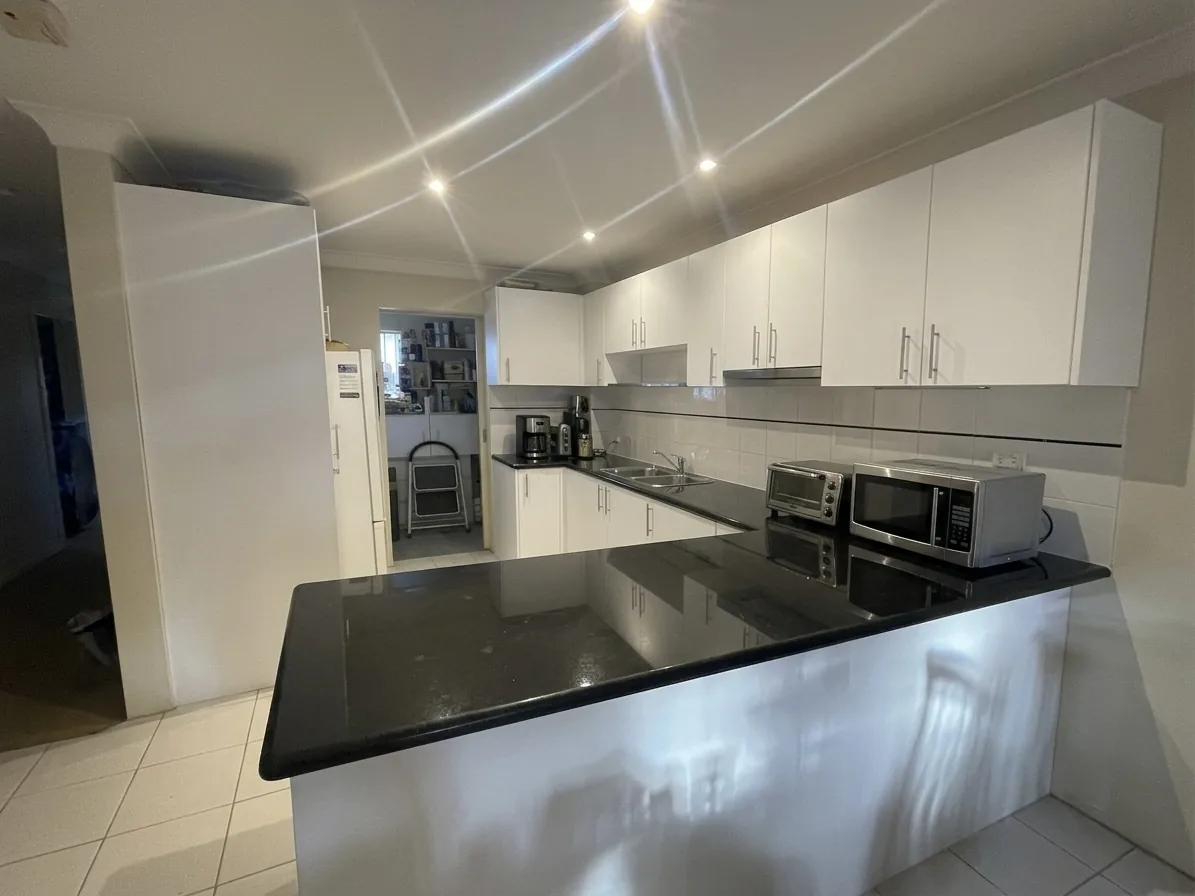
On an Alexandria apartment kitchen we refinished recently, the owner's instinct was that the whole kitchen was finished. In fact the black benchtop, the splashback tiling and the appliances were all sound. What had aged badly was the oak vinyl-wrap doors and panels, plus a failed DIY washing machine cavity cut into the run. We refinished every door, drawer front and exposed panel in 2pac polyurethane, closed up and rebuilt the cavity to match, fitted new chrome D-shape handles — and kept the benchtop exactly as it was. The whole job came in under $10,000 including GST, with no demolition, and the benchtop was never the issue.
So the first test is simple. Stand in the kitchen and cover the doors with your hand, or picture them in a fresh colour. If the benchtop suddenly looks fine, refinish the doors and leave the top alone. If the top is chipped at the edges, lifting at the sink, burnt, or the joins have opened, then it is the problem — and the next question is whether a coating fixes those faults or hides them.
When Resurfacing Is the Right Call, and When Replacing Is
Resurfacing makes sense when: the substrate is sound and flat with no swelling at the sink; you need a cosmetic change for a sale or a lease; the kitchen has a limited remaining life anyway; you can live with trivets and cutting boards as a permanent rule; and the resurfacer's written warranty covers how you actually use the kitchen.
Replacing makes sense when: the benchtop is swollen, delaminated or burnt through; you want to change the shape, add an island, or move the sink or cooktop, since a coating cannot change a cut-out; you are already refinishing the doors and want the kitchen to read as one piece; you want a full-height splashback in the same material, which is one of the strongest single upgrades a kitchen can get; or you simply want a surface that is what it looks like all the way through.
One more factor that favours replacement more often than people expect: laminate has improved. A stone-look laminate from Laminex or Polytec at roughly $80–$200 per metre installed is often within the same money as a coating quote, and it is a genuinely new benchtop with a manufacturer's warranty rather than a skin over the old one.
How We Would Approach Your Kitchen
If you send us photos and a rough plan, we will tell you straight which parts of the kitchen are worth keeping. It is the same assessment we run on every refinish and every kitchen renovation: carcasses, layout, benchtop, splashback and appliances each get a keep-or-replace call, and the quote is built from those calls rather than from a package.
That is how the Alexandria kitchen ended up under $10,000 instead of the $25,000-plus a full replacement would have started at. It is also how we would tell you, honestly, if the right answer is a new benchtop and nothing else — or if it is a resurfacer you should be calling instead of us. Our process starts with an online consultation, so the first conversation costs you nothing but the photos. Send them through and we will start there.
Frequently asked questions
How much does it cost to resurface a kitchen benchtop in Sydney?
Resurfacing is priced per job by specialist coating companies, based on the benchtop area, its condition, the number of cut-outs and joins, and the coating system used. We replace benchtops rather than coat them, so we do not publish a resurfacing figure; get two written quotes from dedicated resurfacers and compare the heat, cutting and warranty conditions closely, not just the price.
Is it cheaper to resurface or replace a benchtop?
Resurfacing is cheaper on the day. Replacing is often cheaper over the life of the kitchen, because a coating that fails at the sink or under a hot pan has to be replaced anyway. A new laminate benchtop at roughly $80–$200 per linear metre installed is frequently close to a coating quote and gives you a genuinely new surface with a manufacturer's warranty.
Can you resurface a stone benchtop?
Coating systems are applied over laminate and stone, but a coated stone benchtop no longer behaves like stone — it takes on the heat and scratch limits of the coating. If the stone itself is sound and only the colour is dated, it is worth weighing that trade-off against a new engineered stone or porcelain top at roughly $400–$900 per linear metre installed.
Can I keep my benchtop and just replace the kitchen doors?
Yes, and it is often the best value option. On an Alexandria apartment kitchen we refinished every door, drawer front and exposed panel in 2pac polyurethane and kept the existing black benchtop, splashback and appliances; the whole job came in under $10,000 including GST with no demolition. If the benchtop is sound and only the doors are dated, that is the job to do.
How much does a new benchtop and splashback add to a kitchen refinish?
In our kitchen resurfacing cost guide, adding a new benchtop and splashback to a door-and-panel refinish typically adds roughly $3,000–$7,000, depending on material and metres — at which point the job is a facelift rather than a resurface.
InsideOut Joinery & Renos is a family-run custom joinery and renovation business based in Liverpool, Sydney NSW 2170, serving homeowners Sydney-wide. Call 02 5000 0402 or email info@insideoutjoinery.au. One point of contact — we organise and manage every trade on your job, with quick turnaround and 12 years of experience. Licensed contractor — licence 383725C, ABN 62 912 909 739.