Kitchen Benchtop Ideas for Sydney Homes
Choosing a benchtop is one of the biggest decisions in any kitchen renovation. This guide covers every material worth considering — stone, laminate, timber, porcelain — with honest costs, real durability expectations and advice from a team that installs them every week across Sydney.
TL;DR: Stone (Caesarstone, Silestone or Quantum Quartz) is the most popular benchtop in Sydney kitchens. It holds up, looks premium and adds resale value. Laminate is the smart budget choice. Timber looks beautiful but needs maintenance. Porcelain is the fastest-growing option in 2025.
Stone Benchtop Ideas
Engineered stone dominates Sydney kitchens for good reason. It handles daily punishment, cleans in seconds and adds genuine resale value. The three brands you'll hear most are Caesarstone, Silestone and Quantum Quartz — all solid choices with different colour and finish ranges.
Caesarstone is the benchmark. Popular Sydney colours right now include Cloudburst Concrete, White Attica and Empira White. Silestone has the edge in stain resistance and now offers a full low-silica range. Quantum Quartz is the Australian-made option and gives excellent value on tighter budgets.
An important fact: since 2024, Australia has banned engineered stone products with high silica content (above 40%) to protect stonemasons from silicosis. Reputable suppliers have moved to low- and zero-silica formulas. When you're quoting stone, confirm the silica content — any licensed supplier should tell you without hesitation.
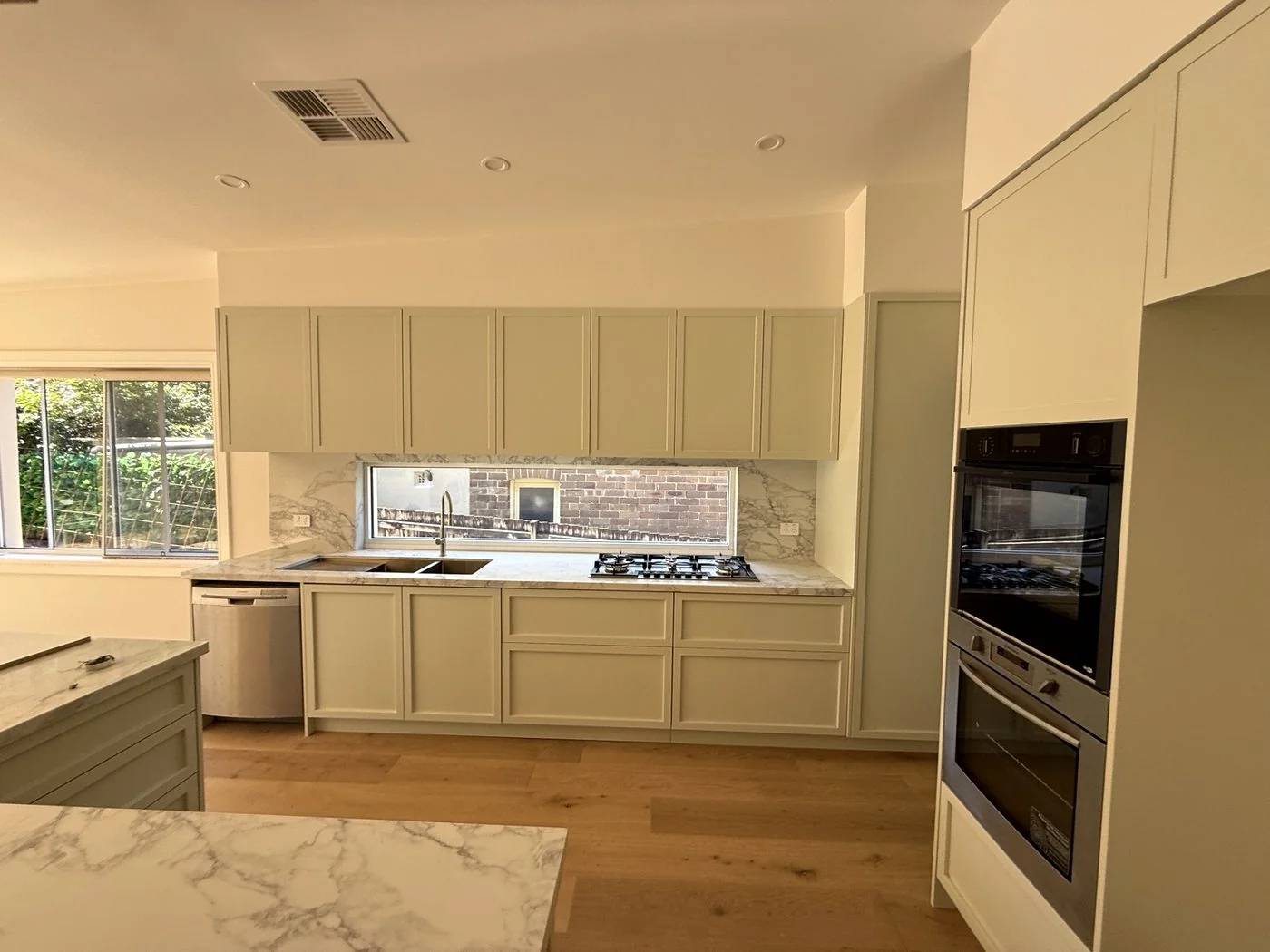
For thickness, 20mm is standard and works in almost every kitchen. A 40mm top or a mitre-join waterfall edge gives a chunkier, more substantial look. Waterfall edges work well on a kitchen island where the slab is a design feature. On a straight run of wall cabinetry, they can feel heavy. Marble-look finishes are popular but choose a honed or textured surface — polished white engineered stone marks easily. For full kitchen renovations, stone is almost always the right benchtop call.
Laminate Benchtop Ideas
Modern laminate is nothing like the thin, chippy laminate of twenty years ago. Laminex and Polytec both produce postform and square-edge benchtops with convincing stone and timber textures that photograph well and hold up in daily use.
Laminate makes sense in a few specific situations. If your kitchen layout has awkward angles, multiple joins or a very long run, laminate gives the fabricator more flexibility than stone. It's also the clear winner when budget is the priority — expect to save roughly $150 to $400 per linear metre compared with engineered stone installed. That adds up fast on a full kitchen.
Where laminate falls short: it scratches with knives, scorches with hot pans and doesn't carry the same resale perception as stone. The joins at corners are always visible, which bothers some people more than others. Heat damage is usually permanent — you can't re-polish laminate the way you can refinish timber.
The best use case for laminate is a rental property refresh, a first-home renovation on a strict budget or a laundry and butler's pantry where you want the same material language as the main kitchen without the cost. On an investment property, laminate is almost always the right call. On your forever home, save for stone.
Timber Benchtop Ideas
Timber benchtops look genuinely warm and beautiful in the right kitchen. Australian hardwoods like blackbutt and spotted gum are durable and characterful. European oak has become very popular in the last few years — lighter in colour, softer in grain, works well with white and greige cabinetry.
The maintenance requirement is real. A timber benchtop needs oiling every six to twelve months depending on use. Skip the maintenance and the surface dries out, cracks and becomes difficult to clean. Around the sink, timber is consistently problematic — constant water exposure causes swelling, staining and eventual delamination no matter how careful you are.
Where timber genuinely shines is on an island bench or breakfast bar that's away from the main cooking and sink zone. Used as a contrast material alongside a stone or laminate primary benchtop, it adds visual interest without the water exposure risk.
If you're keen on timber for a full kitchen renovation ideas project, talk to us about positioning. We install timber benchtops regularly and the material looks best when it's placed where it won't suffer. Pricing sits roughly in the $250 to $600 per linear metre range installed, depending on species and thickness.
Porcelain Benchtop Ideas
Porcelain slab benchtops are the fastest-growing material choice in Sydney kitchens right now. Large-format porcelain tiles have been popular in bathrooms for years — the same logic is now moving into kitchens and it makes sense.
Porcelain is genuinely heat-resistant. You can put a hot pot directly on the surface without damage. Scratch resistance is excellent. UV stability is better than engineered stone, so it won't yellow or fade near windows. The surface is non-porous, which means no sealing ever.
The challenges are practical, not aesthetic. Porcelain is heavier and more brittle than stone during fabrication. Cutting precise openings for sinks and tap holes requires specialist tooling — an inexperienced fabricator will crack slabs. The material is also thicker, which can affect the reveal over cabinet doors.
Cost sits roughly between $400 and $900 per linear metre installed, depending on slab size and complexity. Popular porcelain benchtop brands in Australia include Dekton (by Cosentino) and Neolith, both available through trade suppliers. We source through trade at cost, which helps our clients access these materials at better prices than a retail showroom.
For a modern kitchen with large windows or a north-facing position, porcelain is worth serious consideration.
Benchtop Edge Profile Ideas
The edge profile is a detail most people don't consider until they're looking at samples — but it affects the finished look significantly.
Square edge is the most popular choice in Sydney right now and for good reason. It's clean, contemporary and doesn't date. The edge sits flush and works with every cabinet style from handle-free to shaker.
Bevelled edges (a small 45-degree chamfer) were popular in the 2010s. They're not wrong, but they read as slightly older now. Bullnose — a fully rounded edge — is traditional and still used in coastal and relaxed kitchen styles. It softens the look and is forgiving with young children, but it can feel dated in a more contemporary space.
A mitred waterfall edge is where two slabs are joined at 45 degrees to create a continuous grain running down the side of an island. Done well with matched slabs, it's a strong design feature. Done poorly — or with a material where the internal pattern doesn't match — it looks awkward.
Our general advice: square edge is the safest long-term choice. It photographs well, doesn't polarise buyers at resale and suits almost every kitchen style. If you're doing a waterfall island, go mitred. Everything else, keep it square.
How to Choose the Right Benchtop
Start with how you actually use your kitchen, not what looks good in a showroom photo. Answer these questions honestly before you commit: Do you cook heavily every day? Do you have young children who will scrape cutlery and drop things? Are you renovating to sell in five years or live in for twenty?
Heavy cooks need heat and scratch resistance — porcelain or engineered stone. Families with kids want forgiving, cleanable surfaces — stone or modern laminate. Selling in five years means resale perception matters — stone wins over laminate almost every time.
Always take samples home. A benchtop looks completely different under your kitchen lighting than under showroom fluorescents. Hold the sample next to your cabinet doors, your floor and your splashback tile. Live with it for a few days.
Think about joins. Stone has a visible join every 3 metres. A long kitchen run will have a join — ask to see where the fabricator plans to put it before you sign off.
Finally, ask about the silica content of any engineered stone and ask your installer if they're licensed. In NSW, benchtop installation as part of a renovation requires a licensed contractor. We hold NSW Contractor Licence 383725C and our team has been doing this for 12 years — we'll tell you exactly what we think will work and what won't.
Call Taha on 02 5000 0402 for honest advice and a no-pressure quote.
Frequently asked questions
What is the most popular kitchen benchtop in Sydney?
Engineered stone is by far the most common choice in Sydney kitchens. Caesarstone, Silestone and Quantum Quartz account for the majority of installations we do. White and concrete-look finishes are the most requested colours. Since 2024, Australia has banned high-silica engineered stone products due to silicosis risks in manufacturing, so all current stock from reputable suppliers is low- or zero-silica. Expect to pay roughly $500 to $900 per linear metre installed for a quality engineered stone benchtop, depending on brand, thickness and edge profile.
How thick should a stone benchtop be?
For most Sydney kitchens, 20mm is the right thickness. It's strong, proportional to standard 870mm bench height and keeps the cost reasonable. The slab overhangs cabinet doors by about 20mm which looks balanced. If you want a more substantial look — particularly on a freestanding island — a 40mm top or a 20mm slab with a mitred underside (giving the appearance of 40mm) is worth considering. The mitred option is more expensive in fabrication time but uses less material. Go thicker on showpiece islands; stick with 20mm for wall runs.
What is a waterfall benchtop and is it worth it?
A waterfall benchtop is where the stone continues vertically down the side of an island or cabinet end panel, creating a continuous surface from the top down to the floor. It uses significantly more material — sometimes an entire extra slab — and requires precision fabrication to match the grain or veining at the mitre join. Cost adds roughly $800 to $2,000 to a project depending on slab size and complexity. It works well as a feature on a kitchen island where the design is the focus. On a standard wall cabinet, it's usually unnecessary. We recommend it selectively — not on every project.
How long does a benchtop installation take?
The template is taken after cabinets are installed — usually one day. The fabricator then cuts and finishes the stone off-site, which typically takes five to ten working days depending on the supplier's schedule and complexity of the job. Installation of the finished benchtop takes four to eight hours for a standard kitchen. The sink and tap connection happens after the benchtop is down, adding a half-day for a plumber. Total elapsed time from template to using your kitchen is usually one to two weeks. We coordinate all trades — templating, fabrication, plumbing — so nothing waits on you to chase people.
Can I keep my existing cabinets and just replace the benchtop?
Yes, and we do this regularly. It's one of the best-value upgrades in a kitchen — a new stone benchtop on solid existing cabinets transforms how the kitchen looks and feels. The key requirements are that the cabinets are level (we can adjust with packers if not), structurally sound and the correct height for the new benchtop thickness. If you're also replacing the sink, budget for a plumber. If the splashback is tiled and you're not changing it, we need to be careful at the back edge — we'll discuss the reveal detail during the quote. Call 02 5000 0402 to arrange a measure.
InsideOut Joinery & Renos is a family-run custom joinery and renovation business based in Liverpool, Sydney NSW 2170, serving homeowners Sydney-wide. Call 02 5000 0402 or email info@insideoutjoinery.au. One point of contact — we organise and manage every trade on your job, with quick turnaround and 12 years of experience. Licensed contractor — licence 383725C, ABN 62 912 909 739.