What Is Custom Joinery? A Sydney Homeowner's Guide
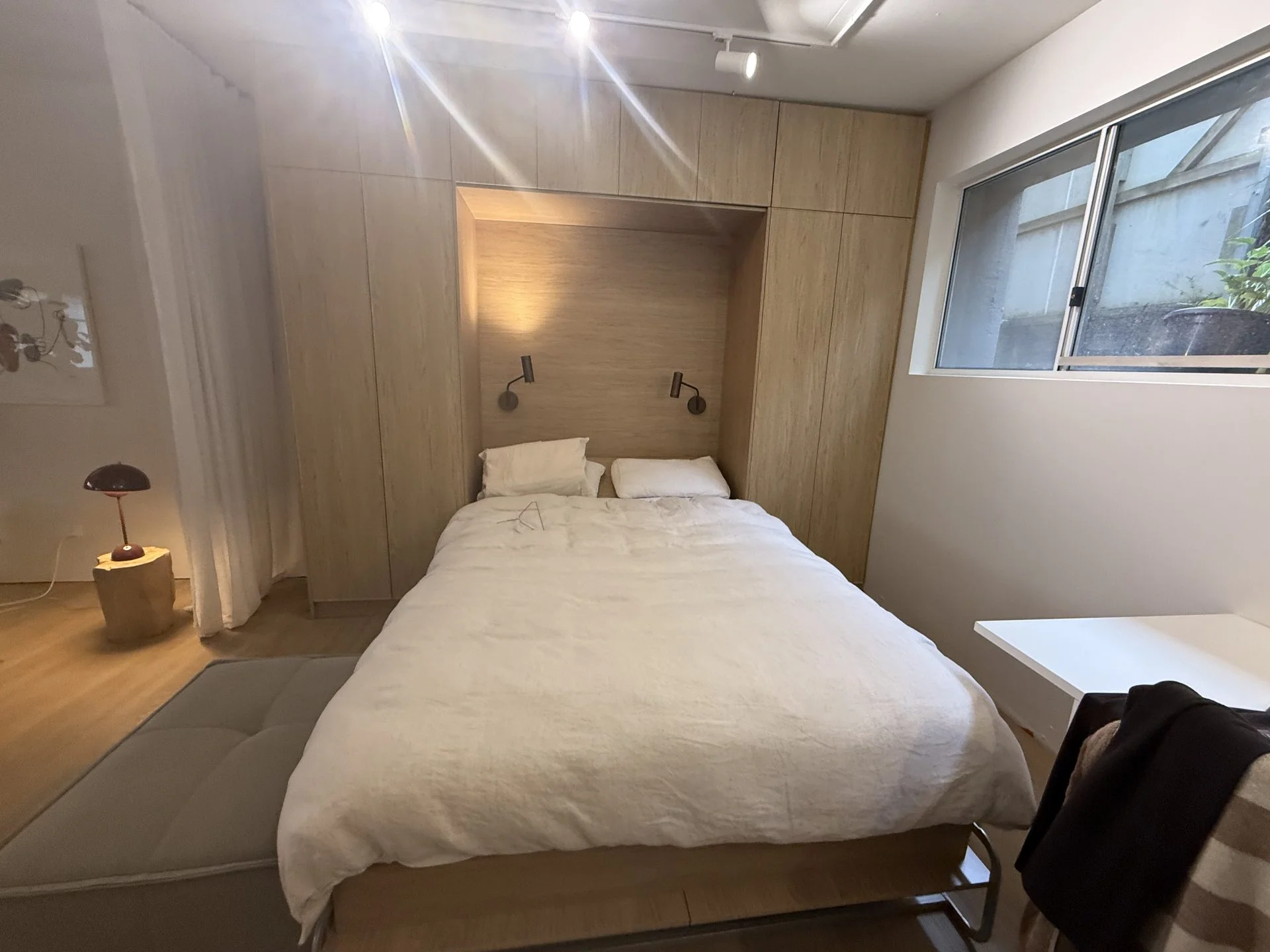
Custom joinery is cabinetry built to your exact space rather than a standard size made to fit. Here is what it covers, how it is made, what it costs in Sydney, and when it is worth the spend.
TL;DR: Custom joinery is cabinetry and storage built specifically for your space — not a standard size adjusted to fit. It uses your exact dimensions, your chosen finishes, and your preferred configuration. In Sydney homes where no two rooms are identical, custom joinery is how you use space properly.
Custom Joinery vs Flat Pack — The Real Difference
Flat pack cabinetry comes in fixed module sizes — 300mm, 450mm, 600mm and so on. You buy the closest sizes to your space and live with the gaps, which usually get hidden behind a filler panel. Custom joinery starts the other way around. We measure your room, then build cabinetry to those exact dimensions, so the run fills wall to wall with nothing wasted.
That's the real difference. Flat pack is a standard size you adapt to fit. Custom is built to fit from the first cut. With custom you also choose the carcass material, the door finish, the hardware, the internal layout and the way it's joined together — none of which you control with a flat pack box.
Where does flat pack make sense? In a garage, a rental, a laundry cupboard or anywhere the budget matters more than the fit and the room is a simple rectangle. There's no shame in it. But in a kitchen, a wardrobe wall or a tricky alcove — the places where Sydney homes are rarely square — custom is what actually uses the space. I'm a licensed joiner based in Liverpool and I build custom joinery across Sydney.
What Custom Joinery Is Used For
Most people think kitchens first, and kitchens are the biggest single use — the cabinetry, the island, the pantry, all built to the room. But custom joinery covers far more than that.
In bathrooms it's the vanity and any tall storage, built to survive a wet, humid room. In bedrooms it's built-in wardrobes that run floor to ceiling and wall to wall, which is where most of the wasted space in a Sydney bedroom hides. In laundries it's overhead cupboards, a benchtop and pull-out storage squeezed into a small footprint.
Then there's everything the standard catalogue ignores. TV and entertainment units built around the cabling and the room. Study nooks tucked into a hallway or under a window. Under-stair storage, which is almost always custom because no two staircases are the same. Shelving that fits an awkward alcove exactly. Even a Murphy bed for a study that doubles as a guest room. I've built all of these in homes from inner-city apartments to family houses out west. If it stores something or hides something, it can be made to fit.
How Custom Joinery Is Made
There are four stages, and knowing them helps you understand where your money goes and why the timeline is what it is.
First we measure. Not a rough idea — exact dimensions of the space, including the things that catch people out, like out-of-square walls, skirting, power points and where the floor dips. Sydney homes are full of these.
Second we design. We work out the layout, the materials, the finishes and the hardware, and you sign off on a detailed scope before anything is cut. This is the stage where you change your mind on paper instead of on site.
Third we manufacture. The cabinetry is cut and built in the workshop to your measurements while the site is prepared. Building off-site keeps the dust and noise out of your home and the work accurate.
Fourth we install. The finished joinery comes in, gets fixed level and scribed to your walls, and the hardware is adjusted. For a typical project we turn the whole thing around in about three weeks once materials are in, because one team runs every stage rather than waiting on outside trades.
What Custom Joinery Costs in Sydney
| Joinery type | Typical Sydney cost |
|---|---|
| Custom kitchen | $20,000–$60,000+ |
| Custom wardrobe | $3,000–$15,000 |
| Custom bathroom vanity | $2,000–$6,000 |
| Custom laundry | $4,000–$12,000 |
| Custom shelving / TV unit | $2,000–$8,000 |
Those ranges are wide because the price tracks the size of the run, the materials and the finish. A small wardrobe in melamine sits at the bottom of its bracket; a large kitchen with stone, a big island and a walk-in pantry sits at the top. The carcass material, the door finish and the hardware brand all move the number. One thing worth knowing — we can supply and coordinate appliances as part of the kitchen, so it is all handled under one quote. Every job comes with a fixed-price quote and an itemised scope, so the number you sign is the number you pay.
How to Choose a Custom Joinery Contractor in Sydney
Start with the licence. In NSW any work over a certain value has to be done by a licensed contractor, and you can look up any licence number on the Fair Trading website in two minutes. Ours is 383725C — check it. If a contractor is cagey about their number, that tells you something.
Next, look at the portfolio. Not glossy catalogue shots — real finished jobs in real homes, ideally ones like yours. Ask to see work that's a few years old, because that shows how the joinery holds up, not just how it looked on day one.
Then the quote. You want a fixed-price quote with an itemised scope and a material schedule, not a vague one-line number. That's the only way you can compare two quotes fairly and know what's actually included.
Ask who manages the job day to day and which trades are in-house. We organise and manage every trade ourselves, so there's one point of contact and no gaps where one contractor blames another. Finally, ask for references and call them. A good joiner will hand them over without hesitating.
Is Custom Joinery Worth It in Sydney?
It depends on the room, but in most cases the answer is yes — and the reasons are practical, not just looks.
The first is space. Sydney homes are rarely square, and floor space is expensive. Custom joinery uses every millimetre — full-height storage, walls filled corner to corner, awkward alcoves turned into useful cupboards. Flat pack leaves dead gaps in all those spots, and dead space in a Sydney home is money sitting idle.
The second is longevity. Custom joinery is built with better carcass material, proper joinery and quality hardware, so it survives daily use and humidity far longer than a flat pack box that swells the first time it gets damp. A kitchen or wardrobe done properly lasts decades, not years.
The third is resale. Buyers notice built-in storage and a kitchen that fits the room. In established Sydney suburbs, well-made joinery helps a home stand out. If you're staying, you enjoy it every day; if you're selling, it works for you at inspection. For a garage or a rental, flat pack is fine — but for the rooms you live in, custom usually pays for itself.
Talk to us about your joinery
If you're weighing up custom joinery anywhere in Sydney, the easiest first step is a chat. Call us on 02 5000 0402, or send through a few photos and rough measurements of the space and we'll come back with a fixed-price quote and a clear scope. No pressure and no obligation — just an honest number and a straight answer on whether custom is worth it for your room. We're a family-run, licensed business, Liverpool-based and working right across Sydney.
Frequently asked questions
What is the difference between a joiner and a cabinet maker in Sydney?
The terms overlap and are often used interchangeably, but there's a traditional distinction. A cabinet maker focuses on the boxes themselves — kitchens, wardrobes, vanities and freestanding furniture built in a workshop. A joiner covers a broader range, including fitted work that's built into the structure of the home: staircases, fitted shelving, panelling and anything scribed and fixed to the building on site. In practice, most Sydney businesses do both, and what matters far more than the title is whether they hold a current NSW licence, build to your exact measurements, and run their own install. Ask to see the licence and the finished work rather than worrying about the label.
How long does custom joinery take to manufacture and install?
For a typical project we turn the whole thing around in about three weeks once materials have arrived, because one team runs every stage rather than waiting on outside trades. Before that, allow roughly two to four weeks for measuring, design sign-off and ordering materials and hardware — imported finishes and certain hardware can have longer lead times, so locking selections in early is what keeps the job on schedule. A large kitchen with stone and a big island, or a job that needs other trades sequenced in, will take longer. A single wardrobe or vanity is quicker. We give you a clear timeline with the quote so you know what to plan around.
What materials are used in custom joinery?
The carcass — the structural box behind the doors — is usually a quality moisture-resistant board, with HMR (high moisture resistant) board used in wet areas like kitchens, bathrooms and laundries. Doors and fronts come in a range of finishes: melamine for a hard-wearing budget-friendly option, laminate, polyurethane (a sprayed painted finish), two-pack, timber veneer, or solid timber. Benchtops are typically laminate, engineered stone or natural stone depending on budget. Hardware — the hinges and drawer runners — is where quality really shows over time, and we use soft-close, properly rated hardware that handles daily use. We talk through every material choice at the design stage so the spec matches both your budget and how the room gets used.
Can custom joinery be done in an apartment in Sydney?
Yes, and apartments are often where custom joinery makes the biggest difference, because floor space is tight and every millimetre counts. We build wardrobes, kitchens, laundry storage, study nooks and entertainment units in apartments right across Sydney. Because we manufacture off-site and install in one go, the disruption inside the apartment is kept short, which matters when you're dealing with building access, lifts and strata rules around noise and work hours. If your building is strata, check whether the work needs any notification or approval — it usually doesn't for internal joinery, but it's worth confirming. We can advise on access and timing when we measure up.
How do I find a licensed custom joinery contractor in Sydney?
Start with the NSW Fair Trading website, where you can search any contractor's licence number and confirm it's current and covers the work — ours is 383725C. Beyond the licence, look for a contractor who shows you real finished jobs in real homes, gives you a fixed-price quote with an itemised scope rather than a vague figure, and can tell you clearly who manages the project and which trades are in-house. Ask for references from recent clients and actually call them. A family-run business that's been going a number of years and stands behind its work is usually a safer bet than the cheapest quote — joinery done badly costs more to redo than to do once.
InsideOut Joinery & Renos is a family-run custom joinery and renovation business based in Liverpool, Sydney NSW 2170, serving homeowners Sydney-wide. Call 02 5000 0402 or email info@insideoutjoinery.au. One point of contact — we organise and manage every trade on your job, with quick turnaround and 12 years of experience. Licensed contractor — licence 383725C, ABN 62 912 909 739.