Kitchen Splashback Ideas for Sydney Homes
Tile, glass, stone, porcelain or painted — the splashback is one of the most visible parts of a kitchen. Here is what actually works in Sydney kitchens, what each option costs, and what to think about before you choose.
TL;DR: The splashback is one of the last decisions in a kitchen renovation and one of the most visible. Tile is the most versatile. Stone continuation is the most premium. Glass is the easiest to clean. Each has real trade-offs worth understanding.
Subway and Feature Tiles
Tile is the most popular splashback in Sydney, and for good reason — it suits almost any kitchen, it's hard-wearing, and the range is enormous. The classic is the subway tile, and the size you pick changes the whole feel of the wall. A 75x150 reads as traditional and busy. A 100x200 is the safe all-rounder. Step up to a 200x400 or a 300x600 and you get a calmer, more modern wall with fewer grout lines.
The grout colour matters more than people realise. Match the grout to the tile and the wall reads as one clean surface. Contrast it — white tile, dark grout — and you make a feature of the pattern. The lay pattern does the same job: a standard brick bond is the familiar offset look, while a stack bond, where tiles line up in a grid, looks sharper and more contemporary.
Installed, tile runs about $60 to $200 per square metre depending on the tile and the detail. It's the most flexible way to get the look you want without the premium of stone. You can see the kitchens we build on our kitchen renovations page.
Stone Continuation
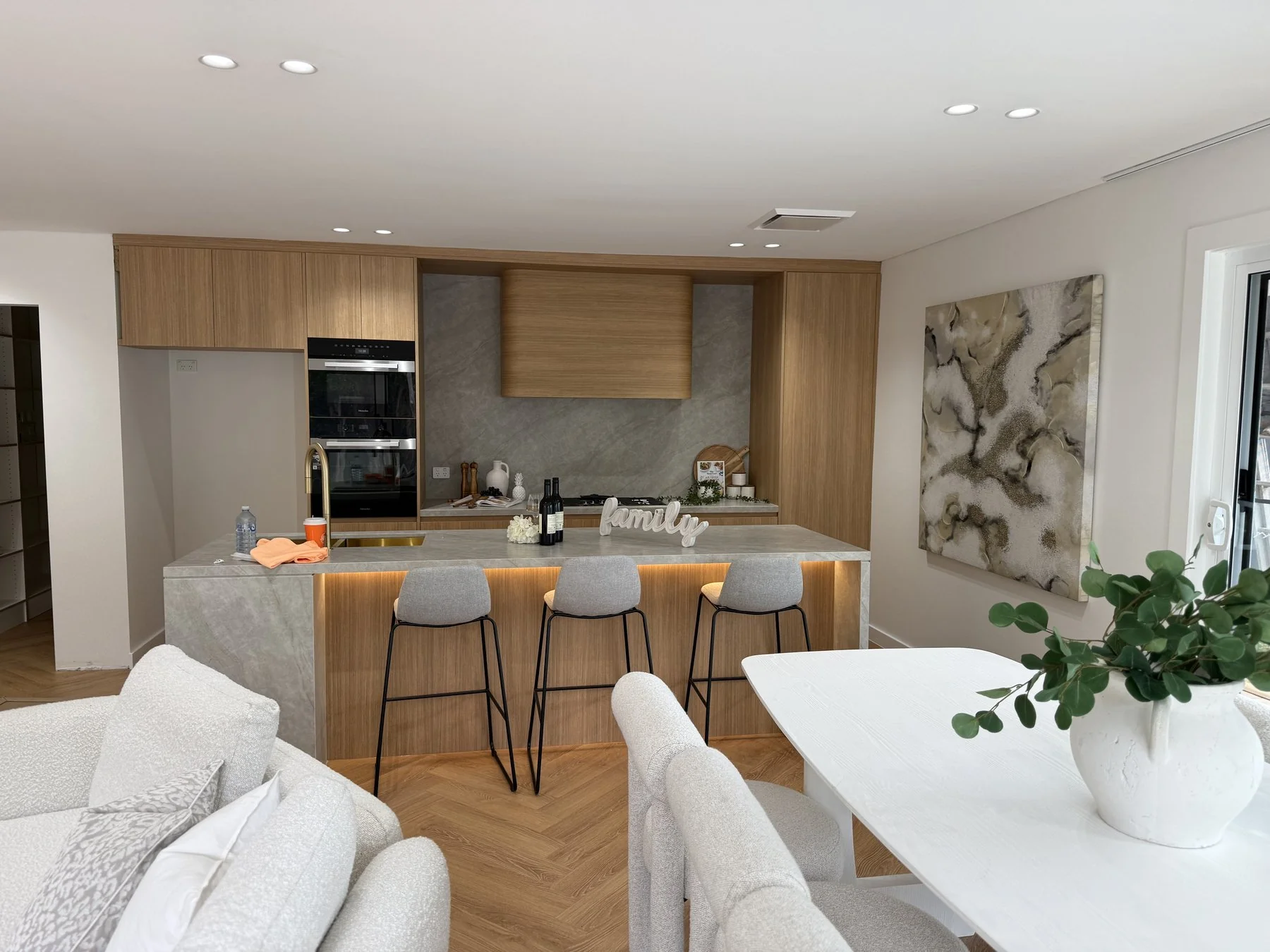
Continuing the benchtop stone up the wall is the most premium splashback you can do. Instead of switching materials at the bench, the same slab carries up behind the cooktop and sink, so the eye runs straight from horizontal to vertical with no break. In a kitchen with a waterfall end, matching the splashback to the benchtop ties the whole island and back wall together.
Where it works is a kitchen where the benchtop is already a quality stone — engineered quartz, porcelain or natural stone — and you want the calmest, most cohesive look possible. Where it doesn't work as well is a long run with lots of cupboards and windows breaking it up, because you lose the continuous effect that makes it worth the spend.
It's priced by the linear metre rather than the square metre, and runs about $300 to $600 per linear metre depending on the stone and the height. That's a real step up from tile, but in the right kitchen it's the detail people notice first. It also means one less material to clean and no grout lines behind the cooktop.
Glass Splashbacks
A glass splashback is the easiest of the lot to keep clean. It's one flat, sealed surface with no grout lines, so a wipe with a cloth and it's done — which is why a lot of Sydney owners with busy kitchens choose it. The glass is toughened and fixed to the wall in colour-backed or printed form, so you can have a solid colour matched to your cabinetry, or a UV-printed image or pattern fired onto the back.
One thing I'll always steer people away from is frosted or heavily textured glass directly behind a cooktop. It looks fine in the showroom, but cooking splatter sits in the texture and is a nightmare to clean — the whole point of glass is the smooth surface, so don't undo it. Stick to a smooth back-painted finish where it counts.
Installed, glass runs about $200 to $400 per square metre. It needs accurate measuring and template work because it's cut to size off-site and can't be trimmed once made, so it's not a DIY job. Done properly it's a clean, low-maintenance wall that lasts.
Porcelain Slab Splashbacks
Large-format porcelain slabs sit between tile and stone. You get the look of a continuous surface — far fewer grout lines than tile, sometimes none at all across a run — but at a lower cost than natural stone and with a finish that handles heat and stains well. Porcelain comes in stone-look, concrete-look and solid colours, so it's a way to get a stone aesthetic without the stone price.
The trade-off against tile is weight and fixing. A large porcelain slab is heavy and has to be fixed to a sound, flat wall with the right adhesive and, often, mechanical support — it's not the same as buttering up a box of tiles. It also needs careful handling and cutting because a big thin slab can crack if it's mishandled. That's trade work, not a weekend job.
Installed, porcelain slab splashbacks run about $250 to $500 per square metre depending on the slab and the prep. If you want the clean continuous look of stone continuation but the budget won't stretch, this is the option that gets you closest.
Painted Wall
A painted wall is the simplest and cheapest splashback, and in the right spot it's genuinely fine. Away from the cooktop and the sink — say behind a run of overhead cupboards, or on a feature wall in an open-plan kitchen that doesn't cop splatter — a good washable paint does the job and saves you real money.
What you want is a quality semi-gloss or satin enamel, not a flat wall paint. The sheen lets you wipe it down, and enamel handles moisture and the odd scrub far better than a matt finish. Plenty of Sydney kitchens have a painted wall in the low-traffic zones and tile or glass only where the action is.
Where it fails is directly behind a cooktop. Heat, oil and steam break paint down fast — you'll get discolouring, peeling and a wall you can't properly clean within a year or two, and you'll end up tiling it anyway. The honest rule is simple: paint the calm zones, protect the working zones with a proper waterproof material. Use it for what it's good at and it'll serve you well.
What to Consider Before Choosing
Before you lock in a splashback, sort out a few practical things. Height is the first. The standard splashback runs 600mm — from the benchtop to the underside of the overhead cupboards. But if you're running open shelving or no overheads, you may want it full height to the ceiling, which changes the quantity and the cost. Decide the height before you price anything.
Power points are next. Sydney kitchens need GPOs along the splashback, and where they land affects the look. With tile you can work around them easily; with glass or stone they have to be cut precisely and located on the plan before fabrication. Get the electrician and the splashback talking early.
Think about the range hood position too — an undermount or canopy hood changes how much wall is exposed and where the splashback stops. Then maintenance: glass and stone wipe clean, tile means grout you have to keep on top of. Finally, if you're renovating to sell, Sydney buyers expect tile, glass or stone behind the cooktop — a painted wall there reads as a cut corner. For more on planning the whole room, read our kitchen renovation ideas guide.
Talk to us about your splashback
If you're planning a kitchen and weighing up splashback options, the easiest first step is a chat. Call us on 02 5000 0402, or send through your plans and a few photos and we'll come back with a fixed-price quote and an honest steer on what suits your kitchen and budget. We organise and manage every trade — the joinery, the tiling, the glass and the electrical all come through us, scheduled in the right order — so you're not chasing five trades to finish one wall. We're a family-run, licensed contractor (NSW 383725C) with 12 years behind us. Liverpool-based and working right across Sydney.
Frequently asked questions
What is the most popular kitchen splashback in Sydney?
Tile is the most popular splashback in Sydney kitchens, and the subway tile in particular. It's hard-wearing, suits almost any style from traditional to modern, and the range of sizes, colours and finishes is enormous, so you can get exactly the look you want without the premium of stone. Larger formats like 200x400 and 300x600 have become more common because they give a calmer wall with fewer grout lines. Glass and stone continuation are both growing in popularity too, especially in higher-end renovations, but tile remains the everyday choice for most Sydney homes because of its flexibility and value.
How much does a kitchen splashback cost in Sydney?
It depends entirely on the material. Installed, tile runs about $60 to $200 per square metre depending on the tile and the detail of the lay pattern. Glass splashbacks run about $200 to $400 per square metre. Porcelain slab splashbacks land around $250 to $500 per square metre. Stone continuation is priced by the linear metre rather than the square metre and runs about $300 to $600 per linear metre. A painted wall is the cheapest option but only suits low-splatter zones away from the cooktop. The final number depends on the height you choose, the wall preparation, and how many cuts are needed around power points and the cooktop.
Can I install a splashback behind a gas cooktop?
Yes, but the material and the clearances matter. Behind a gas cooktop you need a non-combustible, heat-tolerant surface — tile, glass, stone and porcelain all qualify, which is why they're the standard choices. Toughened glass is rated for the heat and is commonly used directly behind gas burners. What you should not do is run a painted wall or any combustible finish there, because heat and oil will break it down fast and it can be a fire risk. There are also minimum clearance requirements between the burners and the splashback under the gas installation standards, so the cooktop has to be positioned correctly. A licensed installer will set this out for you before anything is fixed.
Do I need to remove my old splashback before installing a new one?
In most cases, yes. Tiling over old tiles is sometimes possible if the existing tiles are sound, flat and well-bonded, but it raises the surface, complicates the finish around power points and cabinetry, and can hide problems underneath. For glass and stone continuation the old splashback almost always has to come off, because those materials need a flat, sound wall to fix to. We generally strip the old splashback back to the wall, make good any damage, and start from a proper substrate — it costs a little more upfront but it's the only way to guarantee the new splashback sits right and lasts. We'll tell you which approach your wall needs when we quote.
What splashback is easiest to clean?
Glass is the easiest splashback to clean. It's a single flat, sealed surface with no grout lines, so cooking splatter wipes straight off with a cloth and there's nowhere for grime to sit. Stone continuation and porcelain slabs are close behind for the same reason — minimal or no grout lines. Tile is perfectly cleanable but the grout between tiles needs more attention over time, especially behind the cooktop, and lighter grout can discolour. If low maintenance is your priority, choose a smooth glass or a large-format slab. Avoid frosted or heavily textured glass behind a cooktop — the texture traps splatter and defeats the whole point of choosing glass.
InsideOut Joinery & Renos is a family-run custom joinery and renovation business based in Liverpool, Sydney NSW 2170, serving homeowners Sydney-wide. Call 02 5000 0402 or email info@insideoutjoinery.au. One point of contact — we organise and manage every trade on your job, with quick turnaround and 12 years of experience. Licensed contractor — licence 383725C, ABN 62 912 909 739.