Bathroom Vanity Ideas for Sydney Homes
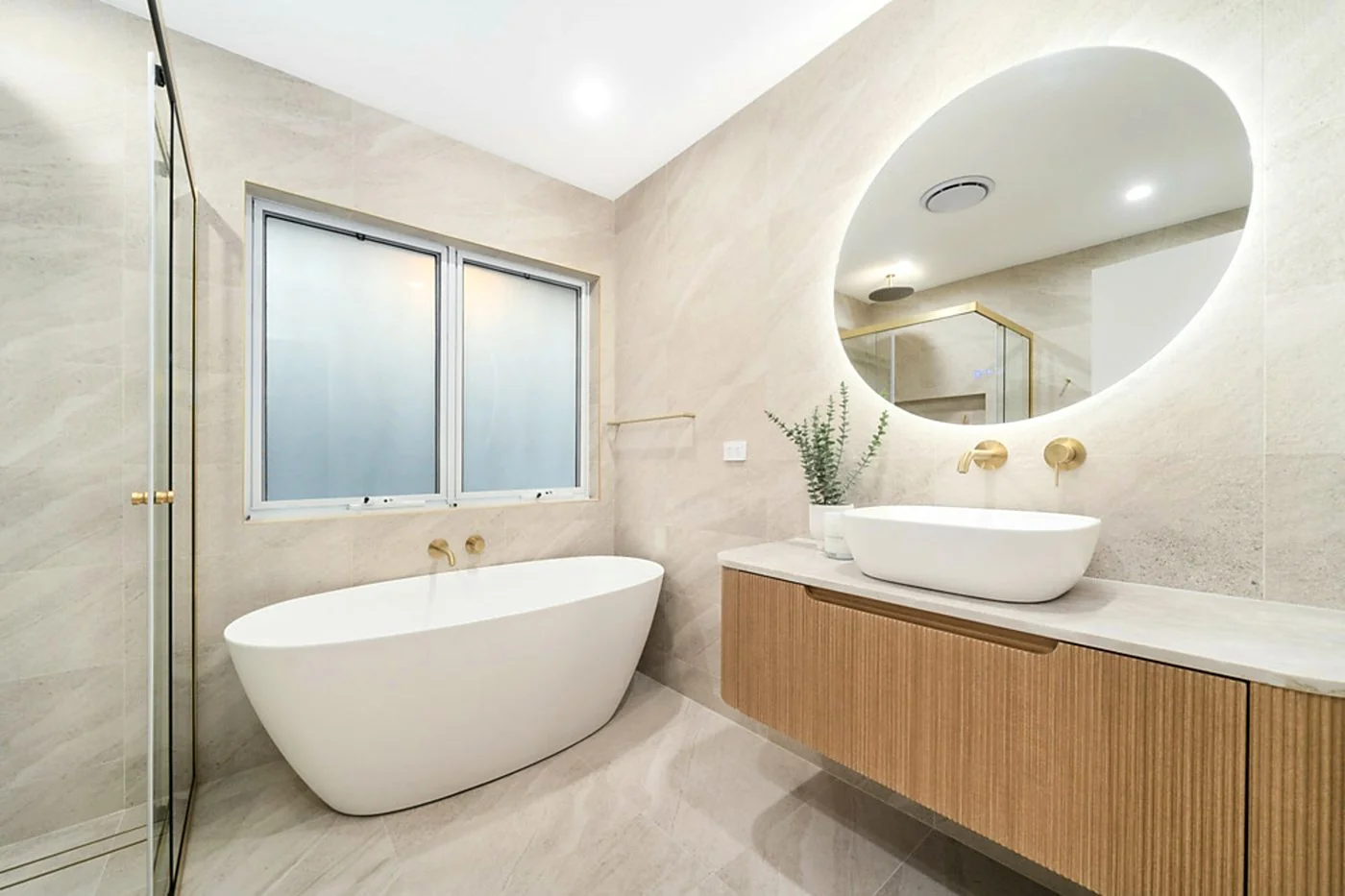
Floating or floor-mounted, single or double, custom or off-the-shelf — the vanity is the hardest-working piece in any bathroom. Here is what actually works in Sydney bathrooms, what lasts, and what buyers want.
TL;DR: The vanity is the most used piece of furniture in a bathroom. Getting the size, style, storage and position right matters more than the finish colour. These are the ideas that actually work in Sydney bathrooms.
Floating vs Floor-Mounted Vanities
A floating, wall-hung vanity is the most popular choice in Sydney right now, and it earns the popularity. With the cabinet fixed to the wall and the floor running underneath it, the room reads as bigger and lighter, and cleaning the floor is far easier with nothing sitting on it. In a small bathroom that visible strip of floor genuinely helps the space feel less cramped.
Floor-mounted vanities still make sense in plenty of homes. They carry more weight without needing heavy wall framing, they suit a traditional or Hamptons-style bathroom better, and they give you a full-height cabinet with maximum storage right down to the floor. If your wall framing is light or you want the most storage you can get, floor-mounted is the practical pick.
The real difference comes down to wall strength and plumbing. A floating vanity needs solid noggins or a backing board in the wall to carry the load, and the plumbing has to be set back into the wall so it's hidden — both of which are easy to plan into a renovation but fiddly to retrofit. We sort that framing as part of the build. See the range on our bathroom renovations page.
Single vs Double Basin
A double basin is a genuine quality-of-life upgrade in a shared or family bathroom — two people at the mirror at once, no morning queue. But it needs the width to work. As a rule, you want at least 1200mm of vanity for two basins to sit comfortably with usable bench space between and beside them. Squeeze two basins into less than that and you end up with no bench at all, which defeats the purpose.
Where a double makes sense is the main bathroom or ensuite of a busy household, or a large bathroom where the width is there anyway. Where it doesn't is a compact ensuite or second bathroom — a single basin with generous bench space beside it is far more useful than two cramped basins with nowhere to put anything.
The storage trade-off is worth knowing. Two basins mean two sets of plumbing taking up cabinet space underneath, so a double vanity actually gives you less usable storage than a single of the same width. If storage is tight in your home, a single basin with a full bank of drawers often beats a double. It comes down to how the bathroom is used.
Custom Vanity vs Off-the-Shelf
An off-the-shelf vanity is cheaper and quicker — you buy it, it arrives, it goes in. The problem is that it only fits if your bathroom happens to match the standard sizes, and most don't. You end up with awkward gaps each side, a depth that doesn't suit the room, or a height that's wrong for the people using it.
A custom vanity is built to the exact width, depth and height of your space, with the drawer layout you actually want and the plumbing cutouts in the right place. It fills the alcove wall to wall, uses every millimetre, and matches the rest of the room. In a wet environment built properly from the right materials, it also lasts longer than a flat-pack unit.
On price, an off-the-shelf vanity might be $400 to $1,500, while a custom vanity typically runs $1,800 to $4,500 depending on size, top and finish. Lead time on custom is usually a couple of weeks for fabrication. The reason most Sydney bathrooms end up custom is simple — no two alcoves are the same size, and a vanity made to fit beats one made to a catalogue. We make ours in-house alongside our custom joinery work.
Vanity Storage Options
How you organise the inside of the vanity matters more than people expect. Drawers beat doors for almost everything — you can see and reach what's at the back without crouching and digging, and a drawer notched around the plumbing still gives you usable space. Doors are cheaper and suit storing bigger items like a laundry basket or cleaning gear, but for everyday toiletries, drawers win.
A shaving cabinet — a mirror with storage behind it — is a smart way to claw back storage in a small bathroom without taking up floor space, and it keeps the bench clear. The trade-off is depth: a recessed shaving cabinet needs wall cavity, while a surface-mounted one sits proud. A separate flat mirror looks cleaner but gives you no storage, so you lean harder on the vanity — a real consideration in a tight room, as our small bathroom renovation ideas guide covers.
Open shelving in or beside a vanity looks great in photos but gets cluttered fast in a real bathroom — everything on display has to stay tidy. Closed storage hides the mess. The tidiest setups we build mix the two: drawers and cupboards for the bulk of it, with maybe one open niche for the things you want on show. Plan the storage around how you actually live, not how the showroom looks.
Vanity Finishes for Sydney Bathrooms
The finish has to survive a wet, steamy room, so material choice isn't just about looks. Painted MDF is common and gives a clean, smooth result, but the paint and the sealing of every edge have to be done properly or moisture gets into the board. Laminate — brands like Laminex and Polytec — is the value workhorse: it's tough, water-resistant, comes in endless colours and woodgrains, and handles a family bathroom well for the money.
Timber veneer gives you real timber grain and warmth, and suits a natural or Japandi-style bathroom, but it needs a quality sealed finish to cope with moisture and isn't the cheapest option. Two-pac — a sprayed polyurethane finish — is the premium choice: a hard, durable, fully sealed surface that resists moisture better than almost anything and gives that smooth, high-end look. It costs more but it's the finish that holds up longest in a bathroom.
For most Sydney bathrooms, a quality laminate from Laminex or Polytec is the sensible balance of cost and durability. Step up to two-pac when you want a premium finish that'll outlast everything else in the room. Whatever you pick, the edges and joins have to be sealed properly — that's where cheap vanities fail first.
Mirror and Lighting Ideas
The mirror does two jobs — it reflects light to brighten the room, and it can store things. A mirror cabinet gives you hidden storage behind the glass, which is the smart move in a small bathroom where every bit of storage counts. A flat mirror looks cleaner and more open, and suits a bathroom that already has enough storage in the vanity. Pick based on whether you need the storage.
Lighting around the mirror is where a lot of bathrooms go wrong. A backlit mirror — LED glowing from behind the glass — gives a soft, modern halo and even ambient light. An edge-lit mirror puts the light around the frame for a sharper look. Both work, but neither should be your only light at the mirror.
The big mistake is a single downlight above the mirror, which casts shadows straight down onto your face — bad for shaving and makeup. The fix is light from the sides, or wall lights either side of the mirror at face height, which lights your face evenly with no shadow. Best of all is a combination: ambient light from above, plus light at the sides. We plan the lighting and the electrical into the build so the mirror, the GPOs and the lights all land where they should.
Talk to us about your vanity
If you're planning a bathroom or just want a vanity that actually fits your space, the easiest first step is a chat. Call us on 02 5000 0402, or send through the dimensions and a few photos and we'll come back with a fixed-price quote and an honest steer on what suits the room. We make our vanities in-house and organise and manage the whole bathroom — the joinery, plumbing, tiling and electrical all come through us, scheduled in the right order. We're a family-run, licensed contractor (NSW 383725C) with 12 years behind us. Liverpool-based and working right across Sydney.
Frequently asked questions
How much does a custom bathroom vanity cost in Sydney?
A custom bathroom vanity in Sydney typically runs $1,800 to $4,500 depending on the width, the benchtop, the finish and the internal fit-out. A compact single-basin vanity in laminate sits at the lower end, while a wide double-basin vanity with a stone top and a two-pac finish sits at the upper end. By comparison, an off-the-shelf vanity might be $400 to $1,500, but it only works if your bathroom matches the standard sizes — most don't. The reason most Sydney owners choose custom is that it's built to the exact dimensions of the room, uses every millimetre, and lasts longer in a wet environment when made properly. We quote a fixed price so you know the number before we start.
What width bathroom vanity do I need?
It depends on the bathroom and how many basins you want. For a single basin, anything from 600mm to 900mm works well, with 750mm being a comfortable all-rounder that gives you a basin plus usable bench space. For a double basin, you want at least 1200mm so the two basins sit comfortably with bench space between and beside them — squeeze them into less and you lose all your bench. In a compact ensuite or second bathroom, a 600mm to 750mm single is usually the right call. The best approach is to measure your alcove wall to wall and build the vanity to fit it exactly, which is the main advantage of going custom.
What material is best for a bathroom vanity in Sydney?
It depends on your budget and how the bathroom is used. For most Sydney bathrooms, a quality laminate from Laminex or Polytec is the sensible balance — tough, water-resistant, huge range of colours and woodgrains, and good value for a family bathroom. Two-pac, a sprayed polyurethane finish, is the premium option: a hard, fully sealed surface that resists moisture better than almost anything and gives a smooth high-end look, though it costs more. Painted MDF and timber veneer both work if the edges and finish are sealed properly. Whatever the material, the joins and edges have to be sealed correctly, because that's where cheap vanities fail first in a steamy bathroom.
How long does it take to get a custom vanity made and installed?
Fabrication of a custom vanity usually takes around two weeks once the design, dimensions and finishes are locked in, and installation itself is generally a day or two depending on the plumbing and the benchtop. If you're doing the vanity as part of a full bathroom renovation, it's built into the overall schedule — we typically turn a standard bathroom around in about three weeks on site once materials have arrived. The thing that slows it down is leaving selections late, so we sort the finish, the top and the basin early. We make our vanities in-house, which keeps the timeline tight and means we can match it to the rest of the joinery in the home.
Can I replace just my vanity without renovating the whole bathroom?
Yes, and it's one of the best-value updates you can make to a tired bathroom. Swapping the vanity, the basin and the tapware refreshes the busiest part of the room without the cost of a full renovation. The main things to check are the plumbing positions — a new vanity needs the water and waste to line up, or the plumbing adjusted — and the floor and wall finish where the old vanity sat, which may need making good. If you're going floating where there was a floor-mounted unit, the wall framing may need reinforcing. We can quote a vanity-only swap, and we'll tell you upfront if anything behind the old one needs attention first. It's a popular update in older Sydney homes where the rest of the bathroom is still sound.
InsideOut Joinery & Renos is a family-run custom joinery and renovation business based in Liverpool, Sydney NSW 2170, serving homeowners Sydney-wide. Call 02 5000 0402 or email info@insideoutjoinery.au. One point of contact — we organise and manage every trade on your job, with quick turnaround and 12 years of experience. Licensed contractor — licence 383725C, ABN 62 912 909 739.