Laundry Renovation Ideas for Sydney Homes
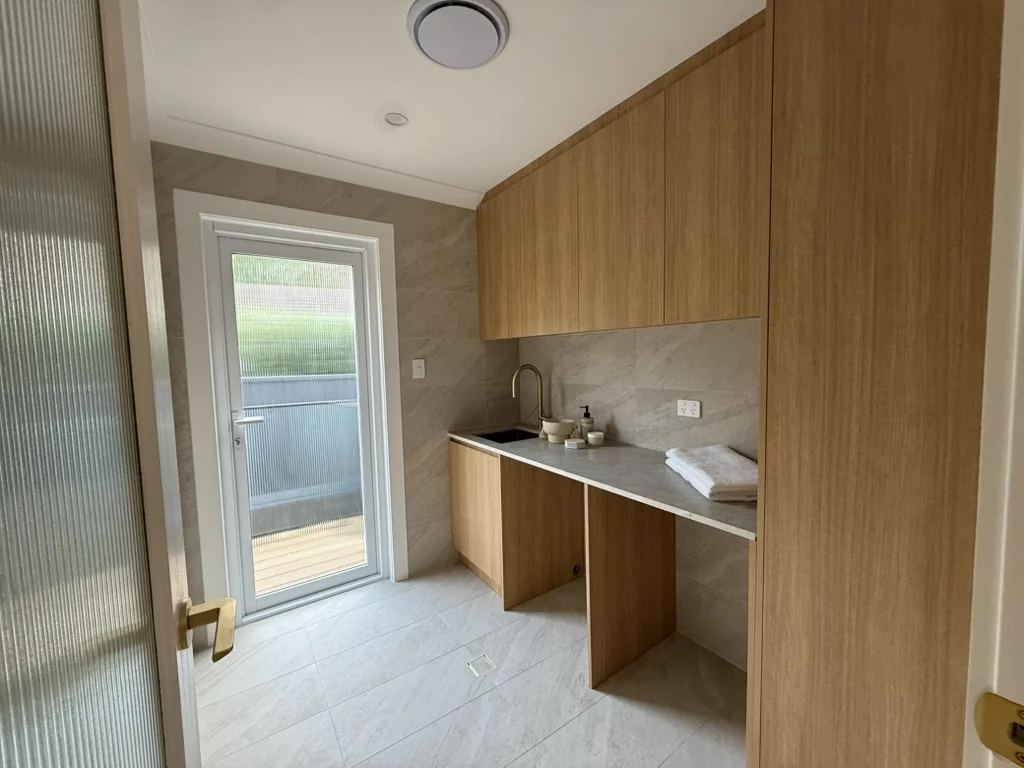
A good laundry renovation solves three things: storage, bench space and machine placement. Here are the layout, storage, benchtop and finish ideas that actually work in Sydney homes — including small apartments.
TL;DR: The best laundry renovations in Sydney solve three problems: not enough storage, no bench space, and machines in the wrong spot. Get the layout right first. Everything else follows.
Layout Ideas for Sydney Laundries
Layout is the decision everything else hangs off, so get it right before you pick a single tile. Most Sydney laundries fall into three shapes. A single-wall layout stacks everything along one run — machines, tub and storage in a line — which suits a narrow room or a converted cupboard. An L-shape wraps around a corner and gives you more bench and storage, ideal for a square room. A galley puts cabinetry on two facing walls with a walkway between, which works in a longer space and gives you the most storage of the three.
Next decision: machines stacked or side by side. Stacking a dryer over the washer frees up floor and bench space and is often the only way to fit a separate dryer into a small Sydney laundry. Side by side gives you a continuous benchtop across the top, which is more useful day to day if you have the width.
The tub usually wants to sit next to the washer for plumbing, with bench between it and the machines. For the door, a standard hinged door eats into a small room — a cavity sliding (pocket) door or a bifold reclaims that swing space and is one of the easiest wins in a tight laundry.
Storage Ideas That Actually Work
A laundry is a storage room that happens to wash clothes, so this is where a renovation earns its keep. The first rule: take overhead cupboards all the way to the ceiling. The standard 600mm overhead leaves a dust-collecting gap above it — running cabinetry to the ceiling turns that dead space into real storage for the things you use less often.
Under the bench, drawers beat cupboards. You can see and reach everything without crouching and rummaging, and deep drawers swallow detergents, cloths and cleaning gear neatly. Build in a pull-out hamper or two — one for darks, one for lights — and you've solved the washing-basket-on-the-floor problem for good.
A few extras that punch above their weight: a built-in fold-down or pull-out ironing board so you're not wrestling a freestanding one; a tall, narrow pull-out for brooms and the mop so they're not leaning in a corner; and a dedicated linen shelf or cupboard if the room can take it. The trick in a Sydney laundry is that these are almost always custom joinery — the room is rarely a tidy rectangle, and built-to-fit storage uses every millimetre that flat pack leaves as gaps.
Bench Space — Why It Matters and How to Get It
Bench space is the thing people miss until they don't have it. You need somewhere to sort, fold, treat stains and rest a basket — and a laundry without bench means all of that ends up on top of the machines or on the kitchen table.
If you've got side-by-side machines, the easiest win is a continuous benchtop running across the top of both. It's the most useful surface in the room and costs little extra once the cabinetry is going in. If the room is too tight for a fixed run, a fold-down bench that drops out of the way when you're not using it gives you the surface without losing the floor.
On material, you don't need to overspend. Laminate is hard-wearing, handles moisture well and is the sensible choice for most laundries — it's a fraction of the cost of stone and does the job. Engineered stone is worth it only if the laundry is on show or flows off the kitchen and you want them to match. On height, set the bench at standard kitchen height, around 900mm, so it's comfortable to work at standing up. A bench that's too low has you stooping every wash.
Sink and Tub Ideas
The laundry tub does more than the kitchen sink in most homes — soaking, hand-washing, filling buckets, rinsing the mop — so it's worth thinking about properly. The first choice is inset versus undermount. An inset tub drops into the benchtop with a visible lip and is the simpler, cheaper option. An undermount sits below the benchtop with no lip, so you can sweep water and mess straight off the bench into it, which is cleaner and easier to wipe down — worth it if you're using stone or a quality laminate.
Size is the next call. A single deep tub is the most versatile for soaking and buckets; a double bowl helps if you do a lot of hand-washing and rinsing. Don't go bigger than you need, though — every millimetre the tub takes is bench space you lose.
Position the tub next to the washing machine wherever you can, because they share the same plumbing wall and it keeps the run tidy and cheaper to plumb. Is a tub even worth it? If you have side-by-side front loaders and limited space, some people skip it and rely on the kitchen — but most Sydney households find a proper tub more than earns its spot once it's there.
Flooring and Waterproofing
A laundry is a wet area, so the floor has to handle splashes, the odd leak and constant mopping without giving up. Two materials do this well. Tiles are the most common — durable, fully waterproof and easy to clean, with the bonus that they match a tiled bathroom or kitchen if the rooms connect. Quality vinyl, particularly the modern plank and sheet products, is softer underfoot, warmer in winter and a good budget option, as long as it's a proper wet-area-rated product and the joins are sealed.
Waterproofing is not optional and not the place to cut corners. Under the NSW building rules and AS 3740, the wet areas of a laundry must be waterproofed to standard by a licensed applicator and the work certified — particularly under and behind the tub and machines, and across the floor if there's a floor waste. A cheap job that skips proper waterproofing prep is the one that fails behind the cabinetry a couple of years later, and fixing a leak that's been quietly soaking your subfloor costs far more than doing the waterproofing right the first time. We handle waterproofing as part of the job, certified to NSW standards.
Materials and Finishes for Laundries
A laundry is humid and gets splashed, so the finishes need to cope with moisture better than a dry room would. For the cabinetry carcass we use HMR (high moisture resistant) board, which resists the swelling that ruins standard board the first time it gets damp. For the doors, a melamine or laminate finish is the practical, hard-wearing choice — it wipes clean, handles humidity and doesn't cost a fortune. Polyurethane is fine here too if you want a painted look and a smoother finish.
For the benchtop, laminate is the sensible default — moisture-friendly, tough and good value. Stone is there if the laundry is on display or matches an adjoining kitchen.
Don't forget the splashback. A tiled or glass splashback behind the tub and along the bench stops water getting into the wall and behind the cabinetry, and it's far easier to wipe down than painted plaster. Good ventilation matters too — an exhaust fan or a window keeps the humidity moving so it doesn't sit in the room and work away at everything. Get the moisture handling right and a laundry holds up for decades. For more on the full process, see our laundry renovations guide.
Small Laundry Ideas for Sydney Apartments
Plenty of Sydney apartments give you about four square metres for the laundry, sometimes less, and often it's a cupboard rather than a room. The good news is a small laundry can work brilliantly if you plan it vertically.
Start by stacking the machines — a dryer over a front-loading washer frees up the floor and lets you put a benchtop or storage where the second machine would have gone. Above the machines, take storage all the way to the ceiling; in a small room the vertical space is the only space you've got spare, so use every bit of it.
Where there's no room for a fixed bench, a fold-down bench gives you a folding and sorting surface that disappears flat against the wall when you're done. A slimline pull-out beside the machines can hold the iron, the broom and cleaning gear in a footprint most people write off as useless. And swap a swinging door for a cavity slider so the door isn't fighting you for floor space. None of this is off-the-shelf — small apartment laundries are where built-to-fit joinery really shows what it's worth, because the standard sizes simply don't fit.
Talk to us about your laundry
If you're planning a laundry renovation anywhere in Sydney, the easiest first step is a chat. Call us on 02 5000 0402, or send through a few photos and rough measurements of the space and we'll come back with a fixed-price quote and a clear scope for the work. No pressure and no obligation — just an honest number and a layout that actually works for the room you've got. We're a family-run, licensed business, Liverpool-based and working right across Sydney.
Frequently asked questions
How much does a laundry renovation cost in Sydney?
Most laundry renovations in Sydney land between roughly $4,000 and $12,000, depending on the size of the room, the cabinetry and the finishes. A small refresh with new cabinetry, a benchtop and a tub sits at the lower end; a larger laundry with stone, a full custom fit-out and relocated plumbing sits at the top. The biggest cost drivers are the amount of cabinetry, the benchtop material, whether you're moving plumbing, and the tiling and waterproofing. We give every laundry a fixed-price quote with an itemised scope, so the number you sign is the number you pay, and there are no surprises once the job is under way.
Do I need council approval for a laundry renovation?
Most laundry renovations don't need council approval, because you're working inside the existing footprint and not touching the building's structure or external walls. Approval or certification usually only comes into play if you're moving plumbing significantly, altering a load-bearing wall, or working on a heritage-listed or strata property where extra rules apply. Waterproofing still has to be done to NSW standards and certified regardless of approval, because it's a wet area. If you're in an apartment, check whether your strata scheme needs to be notified about the work. We'll tell you upfront whether your specific job needs any approvals before anything starts, so nothing trips you up partway through.
Can I relocate my laundry in a Sydney apartment?
Sometimes, but it's more involved than relocating one in a house. Moving a laundry means moving plumbing and drainage, and in an apartment that often runs through the slab or shared service walls, which can be difficult, expensive, or restricted by the building's structure and strata rules. In many apartments the practical answer is to renovate the laundry where it is and make the existing footprint work harder with stacked machines, full-height storage and a fold-down bench. If relocating is genuinely the goal, you'll likely need strata approval and a plumber to assess whether the drainage can be run to a new spot. We can look at your floor plan and tell you honestly what's feasible.
What is the best benchtop for a laundry?
For most Sydney laundries, laminate is the best benchtop — it's hard-wearing, handles moisture and the constant wiping a laundry copes with, and it's a fraction of the cost of stone. Modern laminate also comes in finishes that look the part, so you're not sacrificing the look to save money. Engineered stone is the step up, and it's worth it mainly when the laundry is on show or flows off the kitchen and you want the surfaces to match, or if you regularly do messy, heavy work on the bench. Natural stone is rarely necessary in a laundry. We'll talk through the options against your budget and how the room gets used so the benchtop suits the way you actually do the washing.
How long does a laundry renovation take?
A laundry renovation is one of the quicker rooms to do, and we typically turn ours around in around three weeks on site once materials have arrived, often less for a straightforward job. Before any trades start, allow roughly two to four weeks for design sign-off and ordering the cabinetry, benchtop, tub and fixtures, as some items have longer lead times. The timeline stretches if you're relocating plumbing, doing extensive tiling, or waiting on imported finishes. Because we organise and manage every trade ourselves — the plumber, tiler, electrician and the joinery all scheduled in the right order — the job doesn't stall waiting on outside contractors, which is what keeps the turnaround tight.
InsideOut Joinery & Renos is a family-run custom joinery and renovation business based in Liverpool, Sydney NSW 2170, serving homeowners Sydney-wide. Call 02 5000 0402 or email info@insideoutjoinery.au. One point of contact — we organise and manage every trade on your job, with quick turnaround and 12 years of experience. Licensed contractor — licence 383725C, ABN 62 912 909 739.