Murphy Bed Ideas for Sydney Apartments and Small Homes
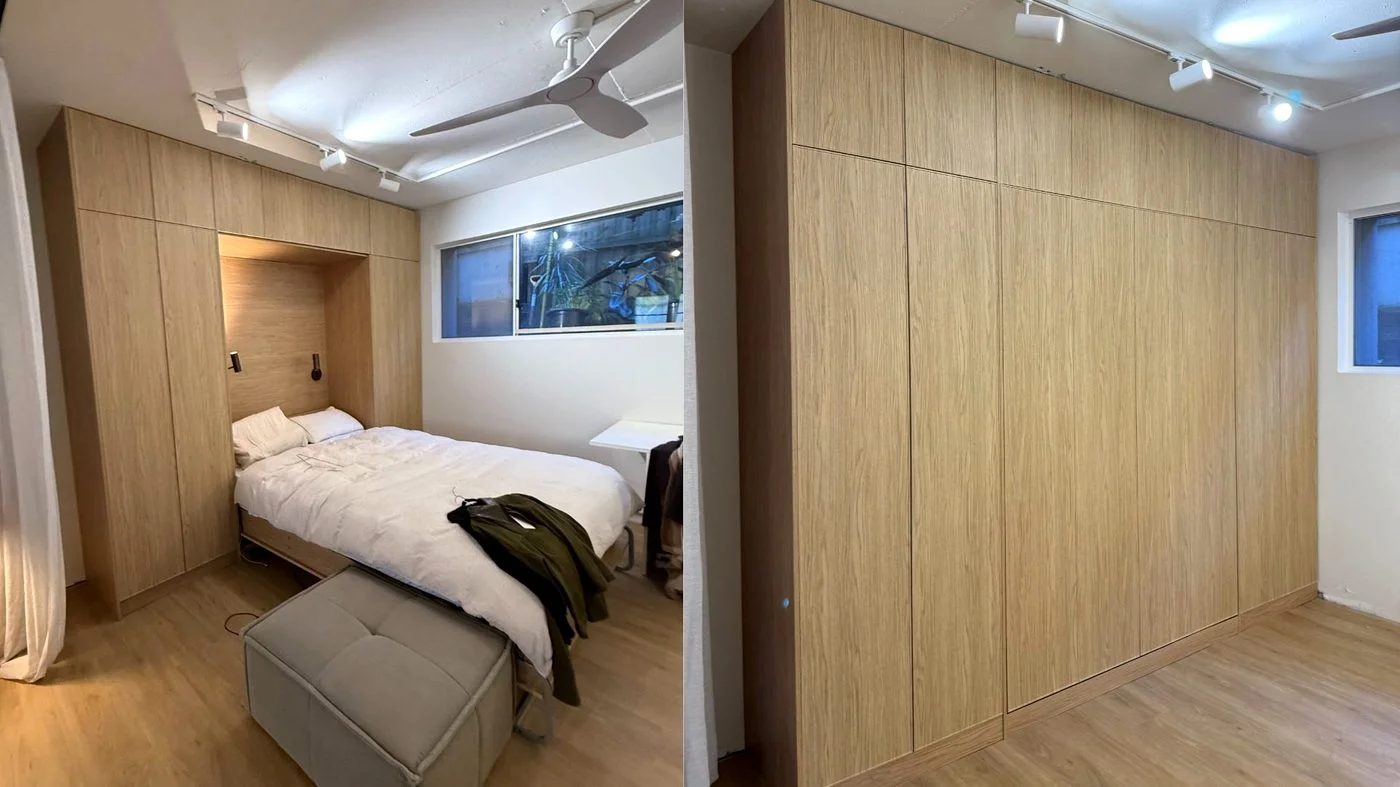
How Murphy beds work, what they actually cost in Sydney, and how to integrate one into a room so you get back the floor space without sacrificing storage or style.
TL;DR: A Murphy bed folds into the wall when not in use, freeing the entire floor area of a room. In Sydney apartments where space is expensive, a well-designed Murphy bed with integrated joinery turns a study into a genuine spare bedroom.
How Murphy Beds Work
A Murphy bed — also called a wall bed or fold-down bed — pivots on a horizontal or vertical axis and folds flat into a cabinet when not in use. The mattress, base and often a slatted frame all fold away together. You get the full floor back.
Mechanism types: Most quality Murphy beds use a gas-strut or piston system. You press the frame down, the struts do the heavy lifting, and the bed lowers smoothly. Older spring-based mechanisms are cheaper but less consistent — the spring tension degrades over time and becomes harder to balance as your mattress ages. For anything you plan to use more than occasionally, a piston system is worth the extra cost.
The cabinet itself fixes to wall studs or a concrete wall via a steel frame. This is load-bearing work — the fixing method matters, and the wall type determines what is needed. Weight capacity on a quality unit is typically 150–200 kg for the mattress and occupants combined.
Mattress requirements are specific: no more than 25–30 cm depth for most mechanisms, with a flexible foam or latex mattress rather than a pocket-spring unit, which is too rigid to fold without damage. Your installer will specify the right type for the mechanism chosen.
Murphy Bed with Integrated Joinery
A Murphy bed in a bare cabinet is functional but misses most of the value. The real gain comes from integrating the bed unit into a full wall of joinery — wardrobe panels either side, a desktop that swings or pulls out, shelving that stays fixed while the bed folds away.
We built exactly this in a Darlinghurst studio apartment. The brief was to make a single room work as both a home office and a guest bedroom. We installed a vertical queen Murphy bed flanked by wall cladding, integrated a servery coffee bench into the cabinetry, and fitted Blum pocket doors that conceal the bed and the pantry storage behind them when not in use. The integrated appliances — including a compact fridge and microwave — sat within the joinery run so nothing read as added furniture. The result was a room that worked fully in both modes.
Integrated joinery adds cost over a freestanding Murphy cabinet — typically $2,000–5,000 more depending on the scope — but it also eliminates the need for separate storage furniture, making back much of that spend. A good shelving and storage layout around the bed is what makes the room genuinely liveable in both configurations.
Murphy Bed Layout Ideas
Horizontal vs vertical orientation: A horizontal Murphy bed folds down from the long side of the mattress — this suits rooms with lower ceilings or where the bed width exceeds the available wall height. A vertical bed folds from the head end and is the more common orientation for double, queen and king sizes because it requires less wall width. For most Sydney apartments, vertical queen is the most practical choice.
Single beds suit a child's room or a narrow study nook. Doubles and queens are the most requested for guest bedrooms and combined study-spare rooms. King Murphy beds exist but are niche — the cabinet footprint becomes large and the room needs to be generous to clear the floor area properly.
Plan for at least 2.4 m of ceiling height for a vertical queen installation, plus 20–30 cm clear space on each side of the lowered bed and 600 mm clearance at the foot. The room does not need to be large — a 3 m × 3.5 m study can take a queen Murphy bed and still function as an office. See our apartment renovation ideas for how Murphy beds fit into broader apartment redesigns.
Murphy Bed Cost in Sydney
Supply and install of a Murphy bed in Sydney runs $4,000–12,000 depending on the size of the unit, the mechanism quality, and how much integrated joinery is involved.
At the lower end — $4,000–6,000 — you are looking at a single or double vertical unit with a quality piston mechanism, a basic timber cabinet, no surrounding joinery, installed into an existing stud wall. That is a functional result with no frills.
Mid-range — $6,000–9,000 — adds flanking panels, integrated shelving either side, and a better finish on the cabinet. The joinery reads as a considered part of the room rather than an appliance bolted to the wall.
At the upper end — $9,000–12,000 — you are getting a full wall of custom joinery: wardrobe storage, a fold-out desk, integrated lighting, and a finished wall panel system. This is where the Darlinghurst project sits.
Flat-pack Murphy bed kits are available for $1,500–3,000 in materials, but they require confident DIY skill and do not suit concrete walls without additional hardware. Custom-built units cost more and last decades. As a family-run, licensed joinery contractor with 12 years of Sydney installations, we source quality mechanisms as part of the build.
Is a Murphy Bed Worth It in Sydney?
In Sydney's property market, a room that functions as a genuine bedroom adds value in a way a study-with-a-sofa-bed does not. A well-installed Murphy bed with joinery reads as a bedroom on inspection — it has a proper mattress, it looks finished, and the room is full size when the bed is not in use.
For Airbnb and short-stay rentals, a Murphy bed in a studio or one-bedroom apartment is a genuine drawcard. Guests can choose to work in the space during the day and sleep in a proper bed at night, which lifts your nightly rate and your reviews.
When a sofa bed makes more sense: if you have the space for a dedicated guest room with a fixed bed, do that. A sofa bed is also the right answer if guests are infrequent — once or twice a year — and you are unwilling to lose the floor space in a room you use daily. Murphy beds earn their keep when the room is in regular daily use as something other than a bedroom, and a proper sleeping option is needed at least a few nights a month.
The payback is strongest in studios, one-bedroom apartments and smaller terraces where every square metre of floor space is working hard.
What to Consider Before Installing
The first question is wall construction. Stud-frame walls are the easiest to work with — we fix the Murphy bed frame directly to the studs with structural bolts. Concrete and masonry walls are also fine but require chemical anchors and more preparation time. Either way, the fixing needs to be done properly; a Murphy bed carries real load and the wall connection is not the place to cut corners.
If you are in a strata apartment in Sydney, check the by-laws before committing. Most strata schemes require an owner to notify or seek approval for any works affecting the structure of the lot or common property. Murphy bed installation typically does not touch common property, but anything involving concrete walls or ceiling-mounted tracks may need a by-laws application. We can advise on what is typically required, but approval sits with the owners corporation.
Installation typically takes one to two days on site — the cabinet goes up, the mechanism is fitted and balanced, and the finish is completed. If the job includes surrounding joinery, allow two to three days. Because we organise and manage every trade, there is no waiting for a separate carpenter to follow a cabinet-maker. Our typical turnaround from confirmed design to installation is around three weeks.
For a quote or to talk through your room, call Taha on 02 5000 0402.
Frequently asked questions
How much does a Murphy bed cost in Sydney?
Supply and install of a Murphy bed in Sydney ranges from $4,000 for a basic single or double unit with a piston mechanism and a simple cabinet, up to $12,000 for a queen unit integrated into a full wall of custom joinery — wardrobe storage, a fold-out desk, and finished panels either side. The main cost drivers are the size of the mattress platform, the quality of the gas-strut mechanism, and how much surrounding joinery is included. Flat-pack kits exist for $1,500–3,000 in materials but suit confident DIYers with stud walls only. A licensed installer with 12 years of Sydney joinery experience is the safer option, particularly in apartments.
Do I need strata approval to install a Murphy bed in my Sydney apartment?
It depends on your strata scheme's by-laws and the construction of the wall you are fixing to. Murphy beds that fix into stud-frame internal walls typically do not affect common property and often fall within standard lot renovation permissions, but you should review your scheme's by-laws and notify the owners corporation regardless. Some schemes require a formal by-laws application for any fixed joinery or structural fixing, particularly into concrete walls or party walls. We can outline what the installation involves so you have accurate information to put to your strata manager before committing. Strata approval sits with the owners corporation, not the installer.
What mattress do I need for a Murphy bed?
Most Murphy bed mechanisms specify a mattress no deeper than 25–30 cm. Flexible foam and latex mattresses work well — they fold comfortably without damage and are light enough for the mechanism to handle consistently. Pocket-spring mattresses are generally not suitable because the spring system is too rigid to compress properly within the folded cabinet, and the weight often exceeds the mechanism's rated capacity. Memory foam mattresses can work if the depth is within specification but check with the mechanism manufacturer first. Your installer should confirm the mattress specification as part of the job — this is not something to determine after the unit is fixed to the wall.
Can a Murphy bed be installed on any wall?
A Murphy bed can be fixed to timber stud walls, concrete walls, and masonry walls, but each requires a different fixing method. Stud walls are the simplest — the steel frame bolts directly to the framing. Concrete and masonry walls require chemical anchors rated for the load, which adds a small amount of preparation time and cost. External walls can be used but need assessment for insulation and vapour considerations depending on the build. The one wall type to be cautious about is a non-structural partition in an older apartment — if the wall does not have adequate framing, additional reinforcement may be needed before fixing. A proper site inspection before design is confirmed will identify any constraints.
How long does a Murphy bed installation take?
Installation on site takes one to two days for a standalone Murphy bed unit — the cabinet goes up, the mechanism is fitted and balanced, and the finish is completed. If the job includes flanking joinery such as wardrobes, shelving panels or an integrated desk, allow two to three days on site. Because InsideOut organises and manages every trade, there is no gap waiting for a separate trade to follow the cabinetry work. From confirmed design to installation the typical turnaround is around three weeks, which covers fabrication of the custom components. There is no extended on-site disruption — a Murphy bed installation is one of the cleaner joinery jobs once the design is locked in.
InsideOut Joinery & Renos is a family-run custom joinery and renovation business based in Liverpool, Sydney NSW 2170, serving homeowners Sydney-wide. Call 02 5000 0402 or email info@insideoutjoinery.au. One point of contact — we organise and manage every trade on your job, with quick turnaround and 12 years of experience. Licensed contractor — licence 383725C, ABN 62 912 909 739.