Kitchen Renovation Cost Sydney 2026 — What Drives the Price
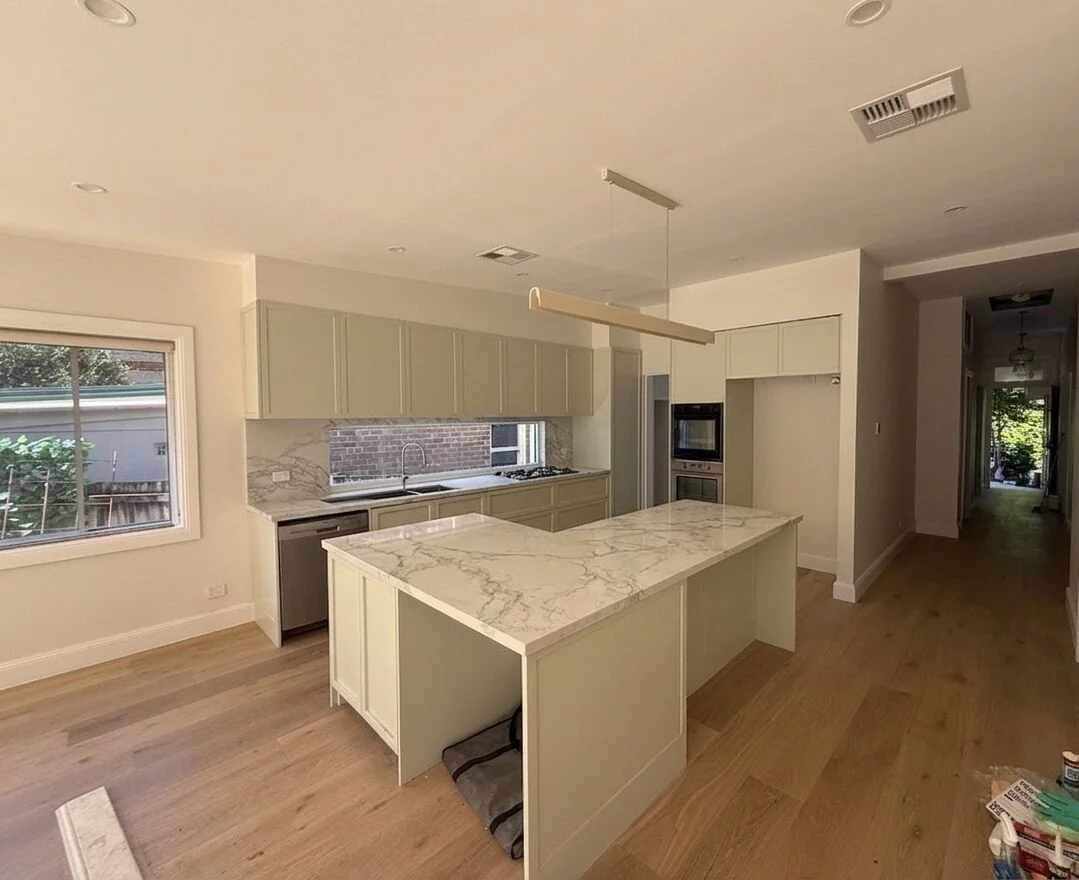
What drives the cost of a kitchen renovation in Sydney? Scope, materials, trades and site conditions all play a role — and understanding the difference helps you brief a job properly before a single door is ordered.
TL;DR: The cost of a kitchen renovation in Sydney varies significantly depending on scope, materials and the complexity of your brief. A surface refresh looks nothing like a full reconfiguration on the quote — even when the finished photo looks similar.
The cost of a kitchen renovation varies significantly
The cost of a kitchen renovation in Sydney varies significantly depending on scope, materials and the complexity of your brief. A kitchen where the layout stays intact and only the cabinetry and benchtop change is a fundamentally different project from one where walls are moving, plumbing is relocating and every trade in the building needs to be coordinated across several weeks.
Two kitchens can look identical in a finished photo and sit at very different points on a price scale. Understanding the factors behind that difference is more useful than a number — because the number only makes sense in the context of the scope it reflects. As a working guide: a surface refresh — new doors, benchtop and hardware in the existing layout — typically sits in the $15,000 to $30,000 range. A full renovation with layout changes and mid-range finishes usually lands between $30,000 and $60,000, with most InsideOut kitchens sitting in the $25,000 to $55,000 mid-range. Kitchens with structural work, premium stone or integrated appliances run $60,000 and up.
Scope: what changes and what stays
Scope is the biggest cost driver in a kitchen renovation — not the brand of your stone or the style of your doors.
Scope covers: whether the layout is changing, whether walls are being removed, whether plumbing is relocating, whether appliances are being integrated into the joinery, and how many rooms the project involves. A focused update — new doors, new benchtop, same carcasses, same layout — adds much less complexity than a kitchen that needs to move position, expand into an adjacent dining room or incorporate a new island where none existed.
A full-scope kitchen also typically involves more trades and a longer project timeline. Each additional trade — structural engineer, plasterer, painter — is a real cost, and the coordination required to get them sequenced correctly adds to the builder's management burden.
Materials: what you see and what you don't
Most of the variation in cabinetry pricing comes from the door finish, not the carcass. The structural box behind the doors — typically 16mm or 18mm HMR (Highly Moisture Resistant) board — is a commodity material. What varies is what goes on the front of it.
Polytec melamine in a standard range — Ravine, Chalk, Sepia Oak — sits at one end. These are durable, low-maintenance and visually clean. MDF doors with a Dulux painted finish in a tone like Lamb's Ear Half or White Polar cost more to produce: they require sanding, priming and spray painting, and they are made to order rather than cut from sheet stock. Polyurethane spray-finished doors cost the most and deliver the most durable, even-coverage finish — the standard in premium builds.
Benchtops follow a similar pattern. Caesarstone's standard range is the most common choice at mid-range levels. Thicker profiles, less common colours, Dekton and custom stone fabrications all add cost. Hardware — Blum soft-close drawer systems, Häfele pull-outs, integrated appliances — adds to the total in proportion to the complexity of what is specified.
Labour and trades
A kitchen renovation typically involves a joiner, a plumber, an electrician and a tiler. The more those trades need to work around each other — or wait for each other — the higher the labour component. A joiner installing new doors into an existing carcass is different from a joiner building the entire kitchen from raw sheet materials, setting carcasses, scribing to walls, fitting the benchtop and handing over to the plumber for the final connection.
Trade availability in Sydney in 2026 remains tight. Electricians and plumbers across most suburbs — particularly Inner West, Northern Beaches and Eastern Suburbs — are booked several weeks in advance. That affects both the timeline and the rate.
Site conditions: what is behind the walls
Site conditions affect kitchen costs more than most clients anticipate. Homes built before 1990 often have plumbing that is in poor condition or not suited to the new layout. Structural walls being removed require a structural engineer and may require a development application, depending on the council. Strata properties have owners corporation requirements around penetrations and waterproofing. Heritage-listed properties may have constraints on how specific rooms can be altered.
None of these are unusual — they are present in a large proportion of Sydney kitchen projects. The cost impact depends on what is found during the assessment and demolition phases, which is why a site visit before the quote is more reliable than a price based on photos alone.
Two real kitchens as reference
Two InsideOut kitchens show how scope and material choice play out at different levels.
The Willoughby project was a four-room joinery fitout covering the kitchen, laundry, wardrobes, vanities and mudroom. The kitchen itself used a hidden finger-pull shaker profile in Dulux Lamb's Ear Half polyurethane — a premium spray-painted finish — with a marble island benchtop, matching marble splashback and a fully integrated oven tower. The scope was deliberate: every daily-use room in the home brought into a single joinery language. That level of detail and coordination takes longer and costs more than a kitchen-only job.
The Epping project took a different approach. A whole-of-home fitout in Laminex Sublime Teak — a warm timber-look melamine — ran consistently from the main kitchen through the butler's pantry, secondary kitchenette, study, wardrobes and laundry. The kitchen was handleless throughout, with a fingerpull profile on all doors and drawers, a stone benchtop and fully integrated appliances. The material choice of a melamine rather than polyurethane finish across many rooms reflects a decision to prioritise consistency and budget spread across the whole home over premium finish in one room only.
Every job is priced on its specific scope. Send us your floor plan, a few photos and what you want to change — we can usually give you a clear budget range within a day. Get in touch here.
Frequently asked questions
How much does a kitchen renovation cost in Sydney in 2026?
Most mid-range Sydney kitchen renovations sit between $25,000 and $55,000. A refresh in the existing layout can come in between $15,000 and $30,000, while structural changes or premium finishes push past $60,000. We quote each kitchen specifically after measuring — the figure you get is fixed, not an estimate.
What is the biggest cost driver in a kitchen renovation in Sydney?
Scope — specifically whether the layout is changing, whether walls or plumbing need to move, and how many trades need to coordinate. A surface refresh with no structural changes is a different cost profile from a full kitchen reconfiguration.
Do I need council approval for a kitchen renovation in Sydney?
Most internal kitchen renovations do not require council approval. If structural walls are being altered, you will need a structural engineer's report and may need a complying development certificate or development application. Your builder should confirm this after the site assessment.
How do material choices affect kitchen renovation costs?
The biggest material variable is the door finish. Polytec melamine sits at the lower end; Dulux-painted MDF in the middle; polyurethane spray finish at the higher end. Benchtop choices follow a similar pattern, from standard Caesarstone ranges to thicker profiles and custom stone.
How long does a kitchen renovation take in Sydney?
Installation typically takes two to four weeks depending on scope. Planning, quoting and fabrication before installation adds another four to six weeks. Structural work, imported materials or complex trade coordination extend the timeline further.
InsideOut Joinery & Renos is a family-run custom joinery and renovation business based in Liverpool, Sydney NSW 2170, serving homeowners Sydney-wide. Call 02 5000 0402 or email info@insideoutjoinery.au. One point of contact — we organise and manage every trade on your job, with quick turnaround and 12 years of experience. Licensed contractor — licence 383725C, ABN 62 912 909 739.