Kitchen Island Bench Sydney: Sizes, Costs, and What Actually Works
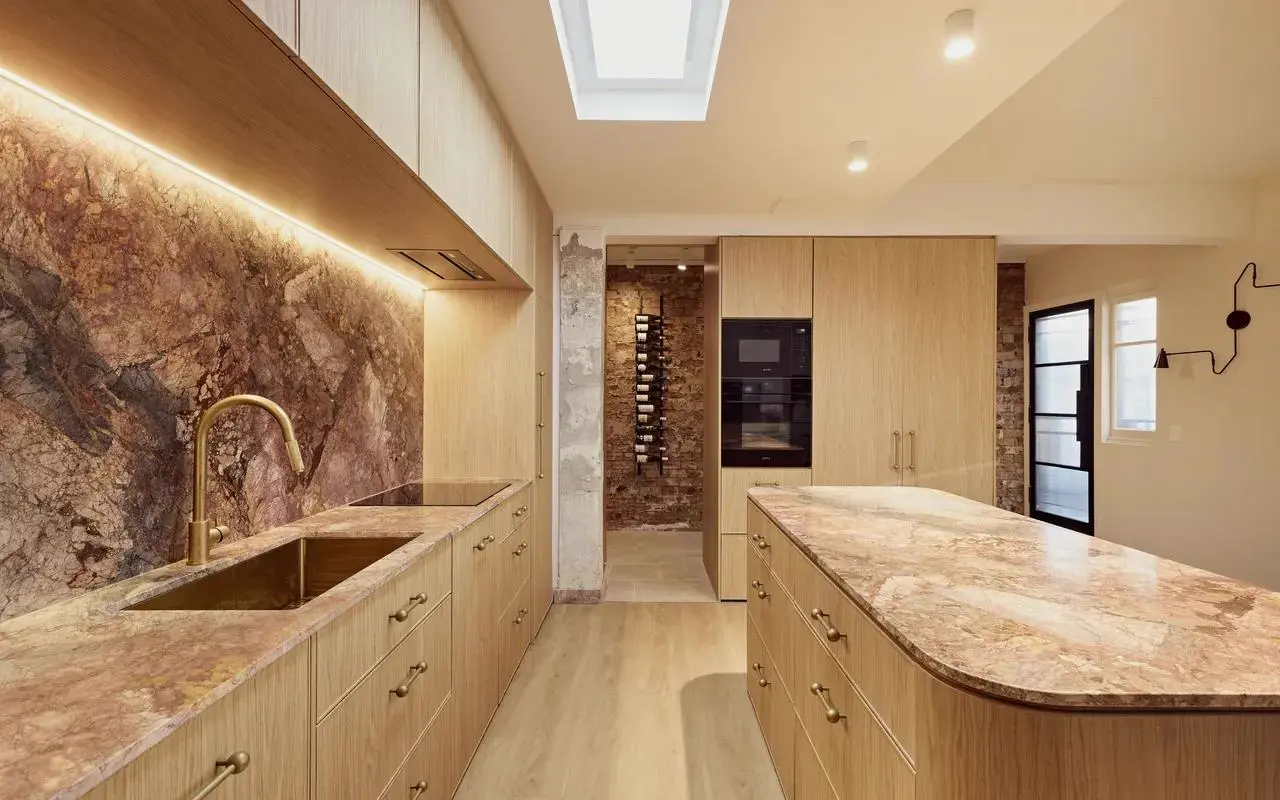
A kitchen island bench is the most-requested feature in Sydney kitchen renovations. Here is what the standard advice gets wrong, what sizes actually work, and how much one adds to a renovation budget.
TL;DR: Minimum workable island: 900mm wide × 1,200mm long, with 900mm clearance on all sides. Below 900mm clearance, two people cannot pass each other comfortably. Islands under 1,200mm long do not have enough benchtop to be useful. Budget $3,000–$8,000 for island cabinetry (not including benchtop). Stone island benchtop adds $1,500–$4,000 depending on size and material.
Minimum Sizes That Actually Work
The most common mistake with kitchen island benches in Sydney homes is installing one that is too small or leaves insufficient clearance. Here are the actual minimum dimensions that work in practice.
Clearance around the island. You need 900mm of clear floor space on every side of the island that a person walks past. This is the minimum — 1,050mm is better, and 1,200mm is comfortable for two people working simultaneously.
900mm is not a guideline — it is a functional minimum. With 750mm of clearance, you cannot open the oven door fully without stepping into the island. With 800mm, two people cannot pass each other without turning sideways. With 900mm, it works. With less, it does not.
Island length. An island shorter than 1,200mm has limited usefulness as a prep surface. 1,500mm is the comfortable working length for one person. 1,800mm+ allows two people to work simultaneously. Above 2,400mm, you are getting into entertaining bar territory — functional but you need the floor space to support it.
Island width. The standard is 900mm total width (including overhang for seating). Without seating overhang, 600mm of benchtop depth is standard. If you want bar stools on one side, add 300–400mm to that side for knee clearance — bringing total island width to 900mm or 1,000mm.
With seating. If you want 3 bar stools at the island, you need at least 1,500mm of island length (500mm per seat). 600mm per seat is more comfortable. For stools to clear the island frame, the overhang needs to be 300mm minimum — 350–400mm is better for thigh clearance.
Total room size. To fit a workable island in a kitchen, the kitchen floor space (not including island) needs to be at least 3.6m × 3.6m. In a 3m × 4m kitchen, an island will feel cramped. In a 4m × 5m+ space, an island works well.
Island Bench Storage Configurations
An island bench is a storage opportunity, not just a surface. The cabinet configuration below the benchtop determines how useful it is in daily use.
All drawers. The most popular configuration for good reason. Deep drawers (180–200mm internal depth) hold more than shelves behind doors — you can see everything at once and do not need to reach past things. A 1,500mm island with 4 deep drawers gives you more accessible storage than the same footprint with doors and shelves.
Mixed drawers and doors. Common for islands with a bin, wine fridge, or dishwasher drawer integrated. Doors on one or two sides, drawers on others.
Open shelving on one side. Works well for cookbooks, baskets, or decorative display. Not practical for items that collect dust or cooking debris — a kitchen island is in the middle of the cooking space and everything open collects splatter.
Appliance integration. The island is the obvious place for a second dishwasher, a bar fridge, wine fridge, or microwave drawer. Each of these requires:
- A cutout of specific dimensions (confirm with the appliance model before drawings are done)
- Ventilation clearance (refrigeration units need airflow — confirm with manufacturer)
- Electrical rough-in to that location
Waste bins. Pull-out bin drawers integrated into the island are convenient. Standard sizes accommodate 20–40 litre bins. Confirm the drawer runner width and bin dimension before ordering — there are incompatible combinations.
Overhangs vs cabinetry. If you want seating on one side, that side of the island typically has no cabinet below — just structural support and the benchtop cantilevering out. The structural support is provided by the adjacent cabinet run, not the island itself. This means the 'seating side' of the island may have limited storage below.
Island Benchtop Options and Costs
The benchtop is often the most visible and most expensive part of the island. Here are the main options and what they cost installed in Sydney.
Engineered stone (Caesarstone, Silestone, Quantum Quartz). The standard choice for Sydney kitchen islands. Durable, non-porous, easy to clean. Price: $600–$1,200/m² installed for standard 20mm thickness. Waterfall ends (stone wrapping over the edge of the island down to the floor) add $800–$2,000 per waterfall side depending on size.
For an island 1,500mm × 900mm in standard 20mm Caesarstone: expect $1,800–$3,000 installed without waterfall ends.
Engineered stone 40mm. Same material, double the thickness. 40mm stone reads as more substantial and is often chosen for islands that double as dining surfaces. Price: $900–$1,500/m² installed.
Porcelain slab. Very hard, very durable, heat and scratch resistant. Requires specialist fabrication — not every benchtop company can work with large format porcelain. Price: $1,200–$2,000/m² installed. The additional cost is typically worth it for islands that see heavy use.
Laminate. Significantly cheaper ($150–$350/m²), not heat resistant, and not appropriate as a primary prep surface in an island that sees heavy cooking use. Suitable for a secondary island used mainly as a serving surface or bar.
Timber. Beautiful, warm, and appropriate for certain kitchen styles. Requires oiling every 6–12 months and is not suitable near water without proper sealing. Price: $400–$900/m² installed. Less common in Sydney kitchens than engineered stone.
What to confirm before ordering stone:
- Edge profile (square, pencil round, bevelled, eased)
- Colour and veining direction (for marble-look stones, direction of veining matters on an island viewed from all sides)
- Templating date — stone is not ordered until cabinets are installed and levelled
How Much Does a Kitchen Island Bench Add to a Renovation?
An island bench adds cost across several categories. Here is a realistic breakdown for a 1,500mm × 900mm island.
Island cabinetry (supply and installation): $3,500–$7,000 This covers the cabinet boxes, doors or drawer fronts, hardware, and installation. An island with all drawers costs more than one with doors. An island with an integrated appliance cut-out costs more again.
Benchtop (engineered stone, 20mm, 1,500 × 900mm): $2,000–$3,500 installed Waterfall ends add $1,000–$2,000 each.
Electrical. If you want power points in the island (common) or an integrated appliance, you need an electrician to run a circuit to the island location. Budget $400–$800 for a basic power point installation, more for appliance connections.
Plumbing (if adding a sink). A second sink in the island requires plumbing — supply lines and waste. Budget $800–$2,000 for plumbing to the island location depending on how far the existing plumbing needs to extend.
Total addition for a workable island: $6,000–$12,000 on top of the existing kitchen budget.
This is why an island is rarely added to a kitchen at the last minute without a budget adjustment — it is a significant line item with dependencies across multiple trades.
Common Island Bench Mistakes in Sydney Kitchens
These are the decisions that create problems after the kitchen is finished.
Too small for the space. Clearances below 900mm create a kitchen that feels crowded with two people in it. If the room does not support a workable island, a peninsula (connected to one wall) is often the better solution — it gets you extra benchtop and storage without needing clearance on all four sides.
Island positioned in traffic flow. The island should not be directly in the path between the back door, fridge, and main kitchen area. Walk the intended traffic pattern before fixing the position.
No power points. Power points in an island are almost always used. Phone charging, small appliances (kettle, blender, food processor). Retrofitting power points after the benchtop is installed requires cutting the stone — expensive and disruptive. Specify power points in the original electrical rough-in.
Waterfall ends specified before the stone is in stock. For a marble-look engineered stone with visible veining, waterfall ends require the stone to be bookmatched — two pieces from the same slab oriented to mirror each other. Not all stone colours are available in bookmatched pairs. Confirm this before you specify it.
Overhang too short for comfortable seating. 250mm overhang is common in drawings. 250mm is too short for comfortable knee clearance on a standard bar stool height of 650–750mm. 350–400mm works. Confirm the overhang dimension before drawings are approved, not after.
For kitchen islands and custom kitchen cabinetry across Sydney — like the stone island in the Leichhardt new build kitchen — InsideOut Joinery & Renos operates from Liverpool and covers Eastern, Inner, North Shore, Western and South West Sydney. Call 02 5000 0402 or visit insideoutjoinery.au.
Frequently asked questions
What is the minimum size for a kitchen island bench?
The minimum workable kitchen island is 1,200mm long × 900mm wide with 900mm of clearance on all walkable sides. Below 900mm clearance, two people cannot pass each other. Below 1,200mm length, the island does not have enough prep surface to be useful. If your kitchen cannot accommodate these minimums, a peninsula (attached to one wall) is a better option.
How much does a kitchen island bench cost in Sydney?
A kitchen island bench adds $6,000–$12,000 to a Sydney kitchen renovation. This includes island cabinetry ($3,500–$7,000), engineered stone benchtop ($2,000–$3,500), and electrical for power points. Adding a sink to the island adds $800–$2,000 for plumbing. Waterfall stone ends add $1,000–$2,000 per side.
What storage configuration works best for a kitchen island?
All-drawer configuration is the most practical for kitchen islands. Deep drawers give you more accessible storage than shelves behind doors — you can see everything without reaching. A 1,500mm island with four deep drawers provides more usable storage than the same footprint with two doors and fixed shelves.
Do I need plumbing in my kitchen island?
You only need plumbing if you are adding a sink or dishwasher to the island. A prep sink in the island is useful for large kitchens where the main sink is far from the prep area. Budget $800–$2,000 for plumbing to the island. Power points, however, should always be included — they are cheap to rough-in during construction and expensive to add later.
How far should bar stools overhang on a kitchen island?
Bar stool overhang should be 350–400mm for comfortable seating. 250mm (common in drawings) is too short — knees and feet hit the island cabinet. At 350–400mm, a person can sit at a standard bar stool height of 650–750mm with thigh clearance. Allow 500–600mm of island length per stool seat.
InsideOut Joinery & Renos is a family-run custom joinery and renovation business based in Liverpool, Sydney NSW 2170, serving homeowners Sydney-wide. Call 02 5000 0402 or email info@insideoutjoinery.au. One point of contact — we organise and manage every trade on your job, with quick turnaround and 12 years of experience. Licensed contractor — licence 383725C, ABN 62 912 909 739.