Kitchen Cabinet Ideas for Sydney Homes
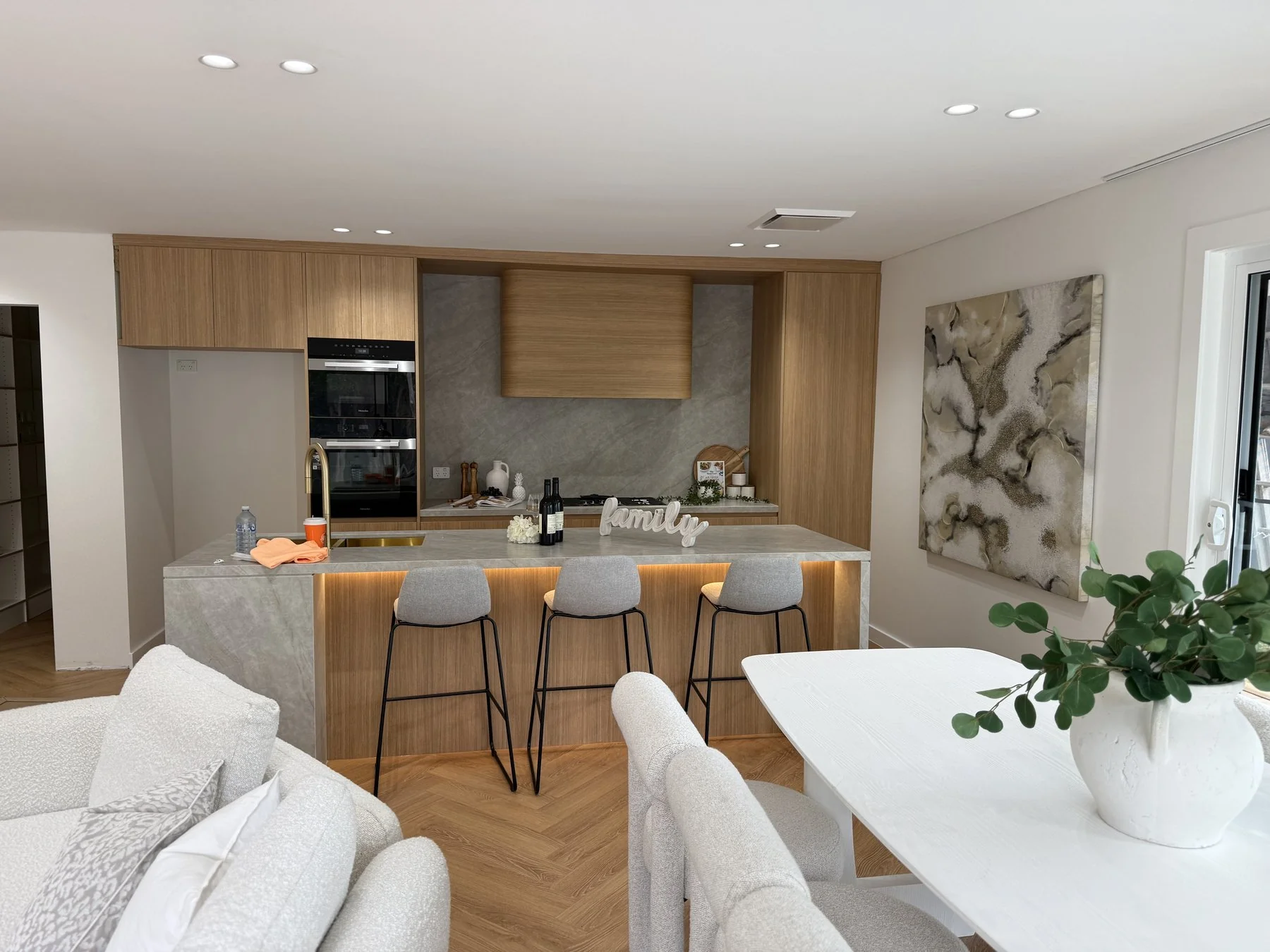
Cabinets are the backbone of any kitchen. This guide covers door styles, finishes, two-tone combinations, handleless options, storage configurations and overhead decisions — with real costs and material advice from a licensed Sydney cabinet maker with 12 years on the tools.
TL;DR: Kitchen cabinets determine how a kitchen looks and functions every day. Door style, finish and internal configuration matter more than colour. Getting the cabinet layout right is the most important renovation decision after the floor plan.
Cabinet Door Style Ideas
Door style sets the personality of the whole kitchen. Shaker doors are the most popular choice across Sydney right now — a simple recessed-panel profile that suits Federation cottages, modern semis and new builds equally well. They photograph well, age well and suit almost every bench material.
Flat-panel doors suit contemporary and minimalist interiors. Think homes built post-2000, open-plan layouts, and spaces where you want the benchtop or splashback to do the talking. They cost slightly less to manufacture than shaker because there's no routing involved.
Handleless designs — whether groove handles or push-to-open mechanisms — add a cleaner look but carry a price premium. Profile doors with decorative routing suit older-style homes and heritage areas like Balmain or Leichhardt where Federation detailing is part of the neighbourhood character.
The rule of thumb: match the door era to the home era. Dropping a modern flat-panel kitchen into a 1920s cottage often looks out of place, no matter how well it's built. Our team walks through this in every quote so you pick a style you'll still like in ten years.
Kitchen Cabinet Finish Ideas
Finish determines durability, cleanability and long-term look more than any other single decision. Two-pac painted finish is the most popular in Sydney. It's sprayed in a factory, cured under heat, and gives a hard, smooth surface that resists chipping. Budget around $800–$1,200 per lineal metre of cabinetry for a full two-pac kitchen. It can be painted any custom colour and re-sprayed later if you want a refresh.
Laminex is the practical workhorse. It covers a vast range of colours and textures, it's scratch-resistant, and it's what you'll find in most mid-range builds. Polytec is a step up — thicker laminate, sharper edges, and a wider range of premium finishes including realistic timber looks. Both Laminex and Polytec are excellent for families because they handle heat and humidity better than paint.
Timber veneer is the premium end. Real timber faces over MDF or plywood carcasses. It adds warmth no laminate can fully replicate, but it needs more care — avoid prolonged moisture and direct sun. Expect to pay 20–35% more than two-pac for timber veneer cabinetry. As a licensed contractor, we manage material supply in-house and keep pricing clear for every client.
For more on how finishes fit into a full kitchen renovations project, see our service page.
Two-Tone Cabinet Ideas
Two-tone kitchens done right look considered; done wrong they look busy. The combination that works consistently is a darker colour on the base cabinets with a lighter colour on the uppers. Charcoal bases with white or off-white uppers is the most requested combination we quote in Sydney at the moment. It grounds the kitchen visually without making the room feel heavy.
A contrasting island is another reliable approach. Keep the perimeter cabinetry neutral — white, warm grey, or natural timber — and use the island as the statement piece in navy, bottle green or charcoal. The island becomes a focal point without committing the whole room to a bold colour.
Colour combinations that tend to fight each other: warm tones paired with cool tones without a unifying benchtop, or too many different colours in a small space. Stick to two colours maximum, use the benchtop to bridge them, and let the splashback stay neutral.
Two-tone layouts that age well use timeless colours — whites, greys, dark greens, dark blues. Trend-chasing combinations like terracotta and sage can look dated within a few years. We've been doing this for 12 years and the clients happiest with their kitchens chose colours they personally liked over whatever was on magazine covers that season.
Handleless Cabinet Ideas
Handleless kitchens look sharp but require the right mechanism for the household. There are three main approaches. Groove handles — a routed channel cut into the top or side of the door — are the most practical. No moving parts, easy to clean, and they work for everyone including kids and people with limited grip strength.
Push-to-open mechanisms like Blum Tip-On use a touch-latch inside the cabinet. You press the door, it springs open. These look incredible with flat-panel doors and create a completely handle-free surface. The trade-off is that Tip-On mechanisms add cost — roughly $30–$60 per door — and can develop inconsistencies over years of heavy use. They're excellent for display cabinets and less-used storage. For everyday base drawers in a busy family kitchen, groove handles often outlast them.
Integrated J-pull profiles sit along the top edge of the door and create a natural grip. They're a middle ground — cleaner than a traditional handle but more reliable than push-to-open for daily use.
For families with young kids, groove handles are the practical winner. For a couple's kitchen or a home where the kitchen sees lighter daily use, Blum Tip-On delivers the cleanest possible look. We specify the right mechanism for how you actually cook, not just how the kitchen photographs.
Cabinet Storage Ideas
Storage configuration is where kitchens win or lose on daily function. Deep drawers under the benchtop beat doors for almost everything except pots and bins. You can see the full contents of a drawer at a glance. Doors mean crouching and rummaging. Most of our kitchen builds now use three-drawer stacks in base cabinets as the default, with doors only where plumbing or structural elements dictate.
Pull-out bins — two or three bins on a single runner — keep waste and recycling inside a cabinet and out of sight. Specify these in your layout before cabinet-making starts; retrofitting them is expensive.
Corner cabinets are the most wasted space in any kitchen. Le Mans carousels are the best performer — two D-shaped shelves that swing out in one motion, giving full access to both shelves. Standard lazy Susans lose items at the back. Dead corners with deep drawers pulling from two directions are another option in the right layout.
Pantry design matters too. A full-height pantry with pull-out drawers on runners is more functional than fixed shelves. You see everything, reach everything. Overhead storage extended to ceiling height is worth doing — use the top section for rarely used items. Kitchen renovation ideas covers more on layout planning before you lock in a configuration.
Overhead Cabinet Ideas
The decision to go to-ceiling or leave a gap above overheads changes the feel of the whole kitchen. Cabinets that run to ceiling height — or close to it with a bulkhead infill — look cleaner, store more, and are easier to keep clean because there's no ledge collecting dust. In kitchens with 2.7m or higher ceilings, going to ceiling is almost always the right call.
In standard 2.4m ceilings, to-ceiling overheads can feel heavy if the kitchen is small. Stopping at around 2.1m and leaving a gap — or using open shelving above — lightens the visual weight.
Lift-up door hardware like Blum Aventos is worth specifying on overhead cabinets wider than 600mm. The door lifts up and stays there rather than swinging out into your face. It costs more than standard hinges but you will use it every day and the mechanism lasts.
Open shelving above the bench is popular in design magazines and genuinely suits some households — those who keep things organised and don't mind dusting regularly. In most family kitchens, closed overheads are more practical. Grease and steam settle on open shelves fast.
For overhead heights, general guide: 500mm overhead depth works well above a 600mm bench; 350mm depth suits spaces where you don't want overheads to feel oppressive. If you want to talk through your specific ceiling height and layout, call us on 02 5000 0402 — we're Liverpool-based and cover all of Sydney.
Frequently asked questions
What is the most popular kitchen cabinet style in Sydney?
Shaker doors are the most popular kitchen cabinet style in Sydney right now and have been for several years. The recessed-panel profile suits a wide range of home styles — from Federation and post-war semis to modern new builds — which is why it keeps selling. In two-pac white or warm off-white, shaker doors read as timeless rather than trendy. Flat-panel doors are popular in more contemporary builds, particularly in Sydney's newer apartment and townhouse stock. What we see less of are heavily ornate profile doors, which tend to appear dated quickly and are harder to keep clean around the routing detail.
How long do kitchen cabinets last?
Well-built kitchen cabinets last 20 to 30 years or more if the carcasses are solid and the finish is properly applied. The carcass — the box itself — is almost never what fails first. It's the hinges, drawer runners, and door finish that show wear. Blum hinges and runners, which we use across all our builds, are rated for 100,000 to 200,000 open-close cycles. Two-pac painted doors can be re-sprayed if the finish chips or you want a colour change. Laminex and Polytec doors typically can't be re-finished, but they resist chips and scratches better than paint in the first place. Twelve years building kitchens across Sydney, the ones that hold up are built with 16–18mm moisture-resistant board carcasses and quality European hardware.
Can I replace just the cabinet doors without replacing the whole kitchen?
Yes, if the carcasses are structurally sound and the door hinge positions are standard. Door replacement — sometimes called a kitchen facelift — is a cost-effective way to update a kitchen that still functions well but looks tired. Budget roughly $3,000–$7,000 for a typical Sydney kitchen door replacement including new hinges, compared to $15,000–$35,000 for a full kitchen renovation. The limitation is that the layout stays the same. If you want to move the sink, add a drawer stack where a door used to be, or change the configuration significantly, you'll need new carcasses anyway. We assess existing cabinets as part of any quote and give an honest recommendation on whether a door replacement makes sense or whether full replacement is the better investment over the next ten years.
What kitchen cabinet finish is easiest to clean?
Two-pac painted finish and Laminex or Polytec laminates are both very easy to clean — a damp cloth handles most kitchen mess. Two-pac has a hard, non-porous surface once cured, so grease and splashes wipe off without leaving marks if you clean them promptly. Laminates are equally easy and slightly more forgiving of abrasion. Timber veneer needs more care — avoid leaving water pooled on the surface and don't use abrasive cleaners. Matte finishes in any material hide fingerprints better than gloss finishes, but gloss is slightly easier to wipe clean when it does get marked. For a household with young kids, a satin or low-sheen two-pac or a matte laminate is the practical choice.
How much do kitchen cabinets cost in Sydney?
Kitchen cabinet costs in Sydney range broadly depending on material, configuration and size. For a standard 3m x 3m L-shaped kitchen, expect to pay $8,000–$14,000 for Laminex or Polytec cabinetry, $12,000–$22,000 for two-pac painted cabinetry, and $18,000–$35,000 or more for timber veneer or premium custom work. These figures are for cabinets only — benchtops, appliances, splashbacks and installation are additional costs. As a licensed contractor with trade accounts, we source at cost and pass the saving through. Appliances sourced through us typically run 15–25% below retail. Call 02 5000 0402 for a site measure and written quote — we cover all of Sydney from our Liverpool base.
InsideOut Joinery & Renos is a family-run custom joinery and renovation business based in Liverpool, Sydney NSW 2170, serving homeowners Sydney-wide. Call 02 5000 0402 or email info@insideoutjoinery.au. One point of contact — we organise and manage every trade on your job, with quick turnaround and 12 years of experience. Licensed contractor — licence 383725C, ABN 62 912 909 739.