Bathroom Renovation Ideas for Sydney Homes (2026)
From layouts that work in tight Sydney floor plans to tiles that stay current in five years, here are the bathroom renovation ideas that consistently deliver — and the ones worth skipping.
TL;DR: The best bathroom renovations in Sydney start with the layout, not the tiles. Get the wet area position, door swing and vanity placement right first. Everything else is easier to decide once the layout works.
Layout Ideas That Transform Sydney Bathrooms
Layout is the decision that costs the most to change later. Everything else — tiles, taps, vanities — is straightforward to update. Move the wet area and you're up for new waterproofing, replumbing, and potentially a structural engineer if there's a wall involved. So get the layout right first.
The question most Sydney homeowners face is whether to keep the wet area where it is or shift it. Keeping it in place and improving what's there is cheaper and faster. Moving the shower from one wall to another might open up the room significantly, but add $3,000–$6,000 before tiles. Sometimes it's worth it. Most times it's not.
Pocket doors: In tight Sydney bathrooms — units, older terraces, small ensuites — the door swing eats usable floor space. Swapping to a pocket door gives back 30–40 cm of clear floor, which can mean the difference between fitting a proper vanity and making do.
Wet-room layouts: For bathrooms under 4 sqm, removing the shower screen entirely and tiling the whole floor on a continuous fall is one of the best ideas going. It reads larger, cleans easily, and removes glass from a tight space. Waterproofing must be done to AS 3740 — there's no shortcut.
Combined vs separate: If the footprint allows, separating the bath from the shower is worth it. A combined bath-shower feels compromised. Separate fixtures let each one do its job properly. Our bathroom renovations page shows layouts across a range of Sydney home types.
Shower Ideas for Sydney Bathrooms
The shower is the part of the bathroom most people use every single day, so it's worth getting right. The first call is the screen: frameless, semi-frameless, or framed. Frameless glass (10 mm toughened) looks cleanest, ages best, and has fewer hardware edges to clean around. Semi-frameless is a solid middle ground. Framed aluminium screens date quickly and are harder to reseal over time.
Configuration matters more than people expect. An alcove shower (three tiled walls, one screen panel) works in a standard bathroom and is easy to waterproof correctly. A corner shower suits a square room with limited length. A walk-in or wet-room layout works best when there's enough floor area for a proper towel-drying zone outside the wet zone.
Niches: Build them into the wall between studs during construction — not after tiling. A niche in the wrong spot is nearly impossible to fix without removing tiles. Standard size is around 300 x 600 mm, placed at shoulder height. Two shorter niches side by side often work better in a couple's shower than one large one.
Heads and floors: Rainfall heads deliver a noticeably better experience for a modest price premium. A 200–300 mm overhead head is the sweet spot for most Sydney bathrooms. Heated shower floors (electric mat under the tile) are a genuine comfort addition in Sydney winters and straightforward to install during a renovation. They are not easy to retrofit later.
Vanity Ideas
The vanity takes up more visual space than any other single element in the bathroom, and it's one of the few things you interact with every day. The key choice is floating versus floor-mounted.
Floating vanities make a room read larger because you can see the floor running underneath. They suit smaller Sydney bathrooms well. The cabinet sits off a frame or wall-hung bracket. Floor-mounted vanities feel more substantial and are useful if you want to hide plumbing inside the cabinet rather than exposing it, which matters in older Sydney homes where the plumbing is less clean.
Single vs double basin in an ensuite: If the vanity run allows for 1200–1500 mm, two basins work well and make the morning rush manageable. Below that, a single basin centred on the wall tends to look better than two cramped basins.
Custom vs off-the-shelf: An off-the-shelf vanity from a tile or bathroom showroom costs $600–$2,500. Custom joinery built to fit the exact wall length costs more — typically $2,500–$5,000 — but fits the room properly, uses better carcass material for a wet environment, and lasts far longer. In a renovation you plan to live with for ten years, it's usually the right call.
Mirror vs mirror cabinet: A mirror cabinet adds storage without touching the floor plan. A flat mirror with a separate LED strip or sconce either side gives better face lighting and a cleaner look. Both have a place — it depends on your storage situation and the size of the wall.
Tile Ideas
Tiles are the most visible choice in a bathroom renovation and they last 15–20 years, so decisions that feel current right now need to hold up. A few ideas that consistently work in Sydney homes.
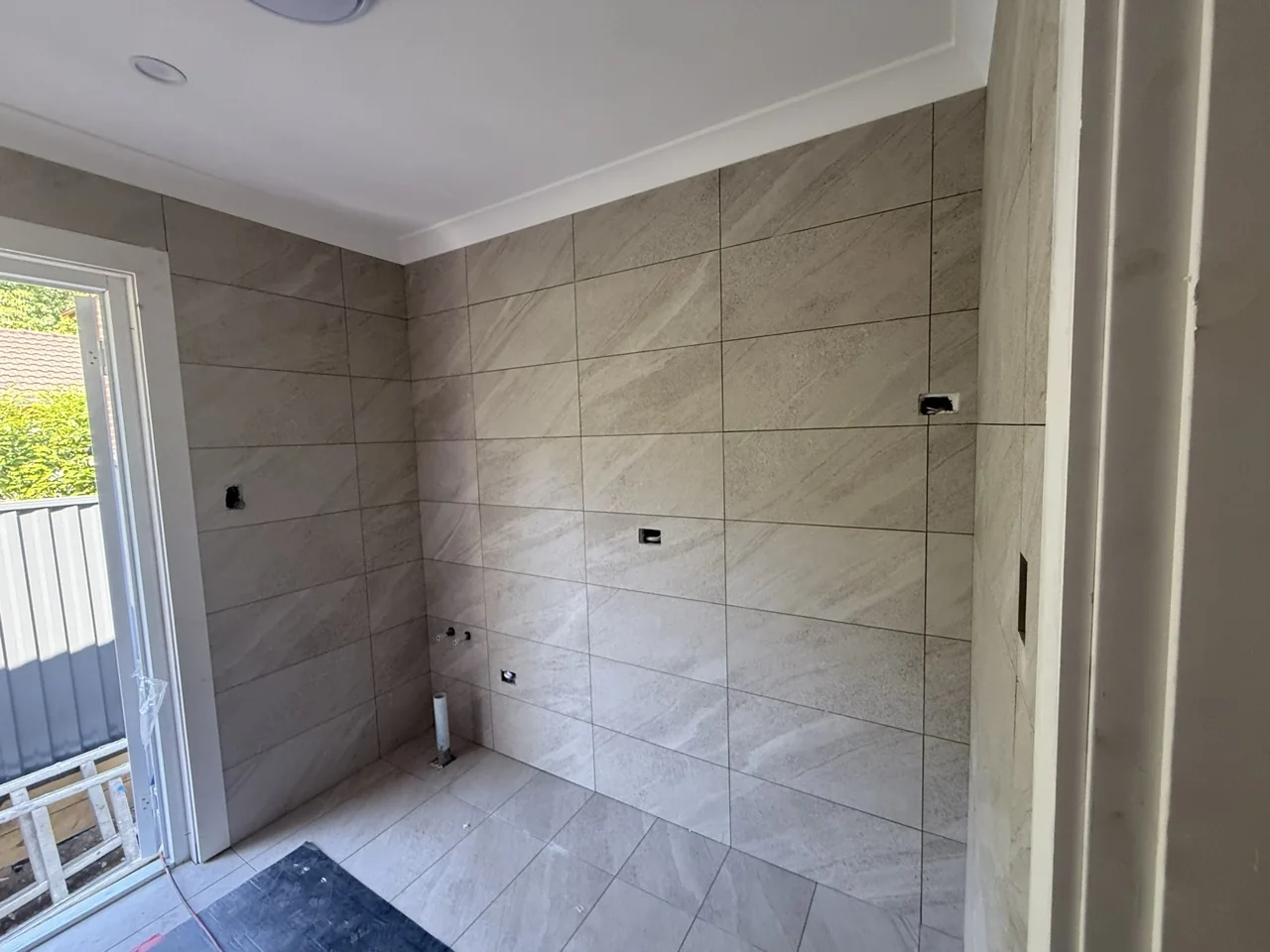
Large-format tiles floor to ceiling: 600 x 1200 mm or 600 x 600 mm rectified porcelain on every wall reads more expensive than it is and has far fewer grout lines to maintain. The larger the format, the more critical the wall prep underneath — any movement transfers directly to the tile. This is not a job to rush.
Feature wall behind the vanity: A single contrasting tile — fluted, textured, or a different tone — on the wall behind the vanity gives the room a focal point without tiling the whole room in a material you might tire of. It's easier to update in the future than a fully tiled feature room.
Continuous floor-to-shower tile: Running the same floor tile from the bathroom floor into the shower without a threshold or change of material is one of the best spatial ideas in a compact bathroom. The room reads as one continuous surface. Waterproofing underneath must be done correctly to AS 3740 for this to work safely.
What dates fastest: High-contrast geometric patterns, heavily veined marble-look tiles, and dark-grout-on-white-tile combinations all follow short trend cycles. White or off-white large-format tiles with matching grout, natural stone tones, and soft concrete-look finishes have consistently stayed current across fifteen years of Sydney renovations. Buy the tile you'll still like when you're selling. Check our bathroom renovation cost guide for how tile selection affects the overall budget.
Bath Ideas for Sydney Homes
Baths divide Sydney homeowners. Families with young children use them constantly. Couples and single-occupant households often don't. The honest advice: if you have the floor space and the budget, keep or add a bath — particularly if you're in a family suburb where buyers expect one. If the bathroom is under 7–8 sqm, a freestanding bath will dominate the room and limit everything else.
Freestanding vs built-in: Freestanding baths look good in photos and feel generous in a large bathroom. They are harder to clean around, require floor-mounted or wall-mounted tapware at the right rough-in position, and need adequate floor area to walk around. Built-in baths use space more efficiently and are easier to maintain. They suit Sydney terraces and apartments where every square metre counts.
Soaking depth: A standard bath is 380–420 mm internal depth. A soaking bath is 450 mm or more. If you use the bath, the extra depth makes a real difference. Check the dimensions against the alcove carefully — a 1700 mm bath in a 1720 mm space leaves no room to waterproof the ends correctly.
Bath position: Against a wall in an alcove is the most space-efficient. Under a window works well for natural light but needs the tapware carefully positioned. Freestanding centred in the room is for large bathrooms only — anything under 10 sqm and it will feel crowded and hard to navigate.
Bathroom Lighting Ideas
Lighting in Sydney bathrooms is often done last and thought about least. That's a mistake — it's one of the hardest things to fix once the ceiling is finished and tiling is done.
Layered lighting: One overhead downlight in the centre of the room gives flat, unflattering light and harsh shadows. A better approach uses three layers: an overhead source for general light, vanity-level lighting for face illumination, and a feature element like a backlit mirror or LED tape in a niche. Each layer does a different job.
Vanity lighting: Light on either side of the mirror (sconces or a horizontal bar) eliminates the under-chin shadow that a single overhead creates. A backlit mirror is a clean alternative — the light wraps around the face rather than throwing a single source from above. Both are straightforward to wire during a renovation. Both are awkward to add afterwards.
Heated towel rails: Hardwired electric rails are a worthwhile addition in a Sydney bathroom where winter humidity makes drying slow. A 600–800 mm rail on a timer switch costs $400–$900 supplied and installed and makes a noticeable difference year-round.
Mistakes that are hardest to fix: Underlit vanity walls, a single IP-rated downlight in the centre of the ceiling, and exhaust fans placed directly above the shower rather than near the door (which draws humid air across the ceiling before it exits). Plan the ceiling layout before the electrician runs cables.
What Bathroom Ideas Add the Most Value in Sydney
Not every bathroom idea returns its cost equally. If you're thinking about value — either for your own use or for sale — here's what consistently matters in Sydney's market.
What buyers notice: Clean, current tiles. A frameless shower. A floating vanity with a mirror or mirror cabinet above it. Proper lighting. A bath if the home has children's bedrooms. These are not expensive features individually, but together they signal that the bathroom has been done properly rather than touched up.
What dates fastest: Heavily patterned tiles. Coloured sanitaryware (anything that isn't white or off-white). Cheap chrome fixtures that discolour within a few years. Pedestal basins in a main bathroom. These features reduce a buyer's confidence that the room will last without another renovation soon.
Timeless vs trendy: Matte black tapware has had a long run and still reads well in 2025. Brushed brass is peaking — it may date within five years. Brushed nickel and chrome are the safest long-term choices. For tiles, soft neutrals and large formats continue to outperform pattern-heavy choices.
Best cost-to-value: A clean full renovation of a dated bathroom in a well-located Sydney home consistently returns a high share of its cost at sale. The mid-range bracket ($15,000–$25,000) tends to deliver the strongest return relative to spend. Premium finishes add value, but rarely dollar-for-dollar.
If you're planning a bathroom renovation and want to talk through what will work best for your home, call us on 02 5000 0402. We're a family-run, licensed contracting business based in Liverpool, and we've been doing this across Sydney for twelve years. One team, one quote, around three weeks on site.
Frequently asked questions
What is the most popular bathroom style in Sydney right now?
The most popular bathroom style in Sydney in 2025 is what you could call relaxed contemporary: large-format rectified porcelain tiles in a soft neutral (warm white, greige or a muted concrete tone), a floating timber-look or stone-finish vanity, matte black or brushed nickel tapware, and a frameless shower screen. Feature walls in fluted or textured tile are common behind the vanity. It's a style that photographs well, ages reasonably and suits Sydney's mix of apartments, terraces and family homes. The look has been consistent for around four years, which suggests it has more staying power than trend-led alternatives.
How much does it cost to add a second bathroom in Sydney?
Adding a second bathroom to a Sydney home typically costs $25,000–$55,000 depending on where it goes, how far the new plumbing has to run, and what finishes you choose. The major cost variables are the structural work (if a wall needs to move), running new waste and water lines to the new location, and the waterproofing. If the new bathroom sits directly above or beside existing plumbing, the cost is at the lower end. If the plumber has to run lines across the full width of the house or through a slab, it increases significantly. Budget the fit-out at $15,000–$25,000 and add the structural and plumbing variation on top.
What bathroom renovation adds the most value to a Sydney home?
A full mid-range renovation of an outdated main bathroom consistently adds the most value relative to what it costs in Sydney. That means a full strip-out, new waterproofing to AS 3740, current large-format tiles, a frameless shower, a floating vanity and updated lighting — typically in the $15,000–$25,000 range. Buyers in Sydney's market are comfortable spending more on a home that has bathrooms they don't have to touch immediately. A dated bathroom, by contrast, gives buyers a reason to negotiate down. Premium finishes add value but rarely recoup dollar-for-dollar. The biggest gains come from bringing a genuinely tired bathroom up to a clean, current standard.
How do I make my small Sydney bathroom look bigger?
The most effective moves for a small Sydney bathroom: use the same large-format tile on the floor and in the shower without a step or threshold — the continuous surface makes the room read as one space. Fit a floating vanity so the floor is visible underneath. Replace a hinged door with a pocket door to recover the swing space. Use a frameless shower screen rather than a framed one. Keep grout lines thin and match the grout colour to the tile. Avoid dark feature tiles on more than one wall in a room under 4 sqm. A backlit mirror rather than a frame-mounted one adds light without taking up wall space.
What bathroom renovation mistakes are hardest to fix?
The hardest mistakes to fix after the fact are structural and wet-area ones. Waterproofing done incorrectly to AS 3740 means pulling out tiles and starting again — there is no patch. Shower niches in the wrong position require tile removal to relocate. Vanity lighting that relies on a single overhead downlight is awkward to improve without cutting into a finished ceiling. Exhaust fans placed above the shower rather than near the door draw moisture across the ceiling before it exits, contributing to mould. Undersized waste pipes that block regularly under a new layout are buried in the floor or wall. None of these are visible until they cause a problem — which is why the scope and the contractor matter more than the tile selection.
InsideOut Joinery & Renos is a family-run custom joinery and renovation business based in Liverpool, Sydney NSW 2170, serving homeowners Sydney-wide. Call 02 5000 0402 or email info@insideoutjoinery.au. One point of contact — we organise and manage every trade on your job, with quick turnaround and 12 years of experience. Licensed contractor — licence 383725C, ABN 62 912 909 739.